Your stock, positioned, where your customers already are.
eBrands operates a fulfillment network of 15 warehouses across four regions, fed by 165 factories and connected to every channel we sell on. You ship your inventory once. From there it sits in-market, close to the customer, ready to move the moment an order lands — with no warehouse contracts, no local entity and no minimum volumes on your side.
Selling in a market is easy. Being physically present in one is not.
A brand can list in a new country in an afternoon. Getting the goods there is the part that stalls. Warehouse contracts come with minimum volumes, long notice periods and a setup cost you commit to before you know whether the market works. So most brands do one of two things, and both cost them: ship every order across the border from home, or sign a local 3PL in each country and inherit four systems that never agree.
We define what mattShoppers compare delivery estimates before they compare products. A brand shipping from outside the market quotes a week while the local competitor quotes two days — and no amount of paid traffic closes that gap.ers, what moves, and what scales
Warehouse agreements are signed on forecast, not on demand. That first commitment is the one brands regret most, because it locks in cost against a market that has not been tested yet.
Four providers means four portals and four spreadsheets. Nobody can answer "how many units do we own, and where" without an hour of reconciliation — and by then it has changed.
15 warehouses. Four regions. One inventory position.
The network is built around the markets our brands actually sell into, weighted towards North America and Europe because that is where the demand sits. Every location is already contracted, integrated and receiving goods — so joining the network means sending stock, not signing a lease.
Upstream, 165 factories feed the network across Asia and Europe — the production end of the same chain, covered on our supply chain and import page.
Five ways to fulfill an order, running side by side.
Most providers have one model and fit every brand into it. We run five in parallel, because the right answer changes by channel, by market and sometimes by SKU.
Stock held inside Amazon's own fulfillment centres in North America, Canada, the UK and the EU, so listings carry Prime delivery promises. We manage the inbound side in depth on our Amazon operations page.
Contracted warehouses across the US, UK and Germany handling direct-to-consumer orders, marketplace orders we fulfill ourselves, and wholesale outbound. This is where stock lives when it needs to serve more than one channel at once.
Inventory positioned inside a marketplace's own logistics programme — Walmart being the clearest example — so the listing inherits that platform's delivery service level rather than ours.
Dedicated capacity for the work that has to happen before goods are sellable: labelling, bundling, repacking to channel spec, and quality inspection on arrival. Getting this wrong is the most common reason a shipment is refused at a fulfillment centre.
Units still being manufactured are tracked as a distinct inventory state, not as a gap in the data. Knowing what is coming and when turns replenishment from a guess into a calculation.
A typical brand runs several of these at once. Because all five report into one system, that mix reads as a single inventory position rather than five disconnected ones.
One brand, one stock pool, every channel drawing from it.
What it looks like when one operator runs the whole footprint.
These are warehouses we contract, integrate and receive into every week, on behalf of the brands we already operate. That distinction matters when you are choosing where to put your stock, because a network that exists on paper behaves very differently from one that is already running. Everything below is drawn from the same system we use to run it.
Every unit, wherever it is, on one screen.
A network this distributed is only an advantage if you can see across it. Every location reports into Apollo Intelligence, our commerce data platform, so stock is one number rather than a reconciliation exercise: units on hand by SKU, warehouse, country and region, days of stock in each location, and stock value per position.
That view is what makes the network operational rather than decorative. It is how a stockout gets caught while there is still lead time to fix it, and how a unit gets rebalanced from a slow location to a fast one before it becomes dead stock.
Most logistics providers stop at the warehouse door.
A network of warehouses is a useful thing to rent. It is a different thing when the operator holding your stock is also the legal seller of the goods, the importer bringing them across the border, and the team running the channel that generated the order.
Worth understanding before comparing us to a 3PL: the warehouse network on this page is one layer of a single operating model. The same operator carries the VAT registrations, the customs entries, the marketplace accounts and the consumer-facing liability.
Common questions about global fulfillment





The model, in plain terms
You keep the brand and the stock. We become the legal seller in every market you choose.
The brand owns
eBrands owns
Six stages. Stages 02 to 06 then repeat for as long as the partnership does.
Channels, markets and SKUs agreed. Joint forecast sets the first order.
You confirm the PO and produce. Lead time and OTIF are measured.
Freight, customs, 3PL. eBrands imports as IoR where contracted.
Live on the agreed channels. eBrands is the legal seller of record.
Monthly statement within 30 days of month-end, then payout.
Sell-through and forward cover trigger the next order.
Performance isn’t a moment — it’s the result of systems running consistently over time. Speed comes from structure, not pressure.
Stage 01 - Forecast & plan
Before anything is built, we agree what sells where, and how much of it to make. Target: live on the first channel in 14–28 days. The one-time setup fee covers listings, content and marketing set-up.
You decide where the brand sells. We advise on fit, competition and landed price, then execute. Nothing launches without your approval.
The first order covers your top performers, not the full catalogue. It bounds the risk while the market is tested, then the range expands.
Food, supplements and cosmetics carry registration work. Compliance usually sets the launch date, not the listing work.
A joint forecast per channel and market converts into the opening PO, sized against manufacturing and freight lead time.
Stages 02–03 · Manufacture, ship and land
You make it. We move it, clear it and store it, at cost with no markup. Who owns the goods in transit depends on which of the two stock models applies
Your side
Our side
Two stock models: when title actually transfers
The rule: customs requires the importer to own what it imports. If we import it, we buy it before it crosses the border.
Flash sale
Cross-border settlement
Stage 04 - Selling
One setup, every channel you approve. You set the price; we run the shop floor. Media and influencer spend passes through at cost. We take no commission on it, and we do not fund it.
You
eBrands
Stage 06 - Replan
Sell-through decides the next PO. The loop closes here and starts again.
What we hold each other to
Standard tier targets. Amber is the alarm, not red: root cause starts before a target is missed.
What it costs?
Four components. Nothing else, and no revenue share. We take the commission. You take the rest.
Of net sales, excluding taxes. Earned only when you sell. Covers compliance and supply-chain management.
Scoped to how many channels we run and how large your portfolio is. Funds proper resourcing from day one.
Per new channel or market. Listings, content and marketing set-up: the work that makes a channel perform.
Logistics, fulfilment, freight, duty, storage, media. No markup, ever.
How we run it together
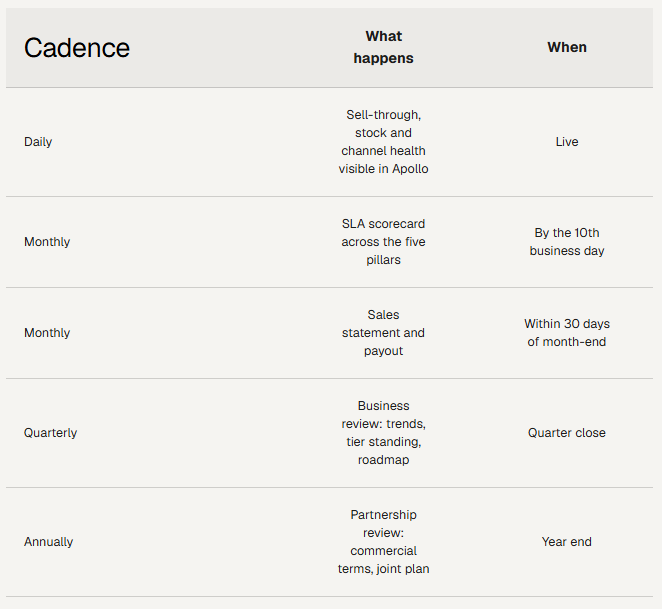
The five SLA pillars: stock availability · inbound and fulfilment · data and communication · issue management · quality and compliance. Targets and remedies are agreed jointly per partner before they take effect.
.png)







Ready to go global?
Let us show you how eBrands can take your brand to every market that matters.