Sell in Europe, the UK and the US without setting up the company or carrying the admin.
We become the legal seller and the importer for your brand: the entity, the VAT, the compliance, the returns, the channel operations. None of that is visible to your customer, who buys from the same store in the same packaging and only sees our name on the receipt. You keep the brand, the pricing, the range and the channel mix.
Most brands start with the EU, UK and US. We also operate Canada and Australia as secondary markets. No local entity. No VAT registration. No compliance stack in the target market for you.




Getting into a new market costs more than the market is worth at first.
Most brands stall in the same three places. None of them are about the product, and all three are fixed costs you commit to before the first sale.
Selling into the EU or the US means an entity, VAT registrations, EPR and a compliance position in every market. All of it is fixed cost, and all of it is committed before a single unit sells.
Someone has to actually run the channels. Hire them and you carry the cost through every slow month; use an agency and you pay for effort rather than outcome.
Entity formation, VAT and EPR registrations, 3PL onboarding and seller-account approvals each sit in their own queue. That runs into months, and the window you spotted usually moves.
None of this is work your customer will ever see, and on a small team it competes directly with the work they do. Every hour that goes into VAT thresholds and 3PL contracts is an hour not spent on demand and on the brand. That is the real cost of running it yourself, and it never shows up on a budget line.
Where your goods start decides when they become ours.
Everything else about the model is identical. This is the fork, and it is worth thirty seconds before the detail.
Cleared, in free circulation
On a channel we run for you
eBrands is the legal seller
Reconciled monthly
Title passes late — at the moment of the consumer order. You own the inventory right up to that second.
Anywhere in the world
eBrands is named on the customs entry
Owned by us, sold by us
Reconciled monthly
Title passes early — before the goods enter free circulation, because customs requires the importer to own what it imports. Ownership transfers on paper so customs has an importer that owns the goods — the economics stay yours.
Now pick yours, and see it step by step.
The money works the same way in both, and so does the payout. The only thing that changes is when title passes to us.
Choose the one that fits you— select an option to see how it works
Use this when your stock is already inside the destination market — cleared and in free circulation, or held in a free-zone market. There is no import event left to run, so title moves at the moment a consumer orders.
Already cleared and in free circulation, in our warehouse or in the marketplace network.
On the marketplace, the D2C store or the social channel we operate for you.
We buy the unit from you as a flash sale, then sell it on as the legal seller.
One monthly statement — product sales, less costs and commission, within 30 days of month-end.
Use this when your stock starts outside the destination market and eBrands brings it in. Customs requires the importer to own what it imports, so title moves to us earlier — an ownership transfer on paper, before the goods enter free circulation.
Title passes to us at the gate, or at the point of import — before release into free circulation.
An eBrands entity is named on the customs entry under our own EORI, and pays duty and import VAT.
Into our 3PL or the marketplace network, owned by us, sold by us as Merchant of Record.
One monthly statement — product sales, less costs and commission. Same settlement as the in-market model.
Plan for this
So the first order should be your proven top sellers only, in a quantity the market can realistically absorb — not the full catalogue. Once we can see how the range prices and lands locally, widening it is quick and low-risk. We will tell you if we think an opening order is too wide.
One consumer sale, all the way down
Illustrative, on a €100 retail price in Germany. The shape holds at any price point; the rates change by market, category and scope.
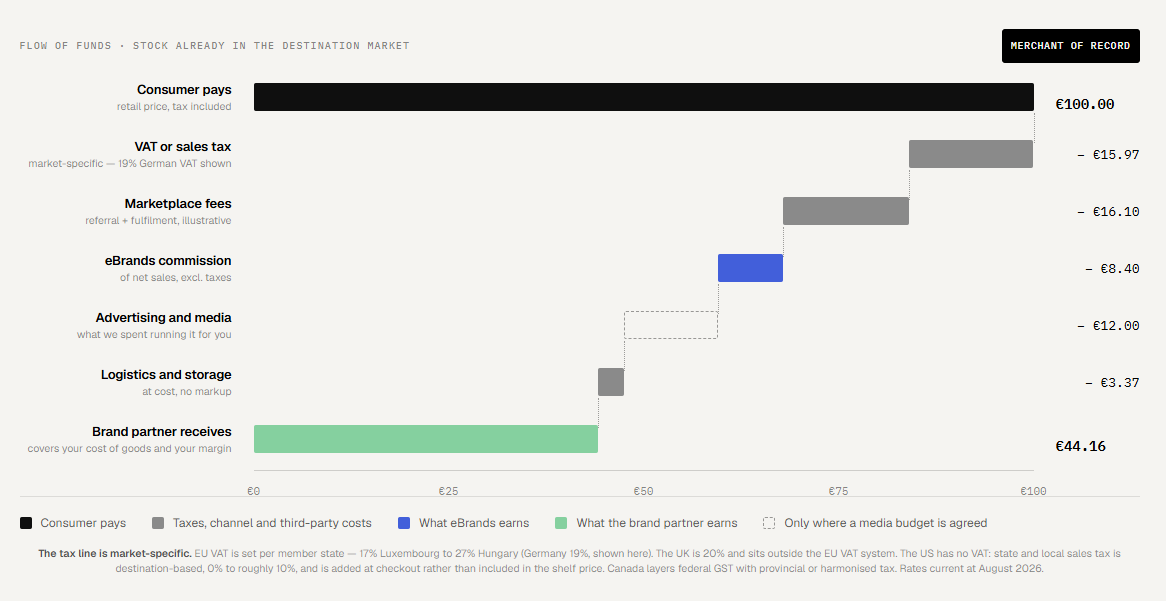
No border is crossed in this structure, so there is no customs duty, no inbound freight and no clearance cost in the waterfall at all — the logistics line is domestic handling and storage only. There is also no unsold-stock exposure, because the stock stays yours until it sells.
One consumer sale, all the way down
Illustrative, on a €100 retail price in Germany. The shape holds at any price point; the rates change by market, category and scope.
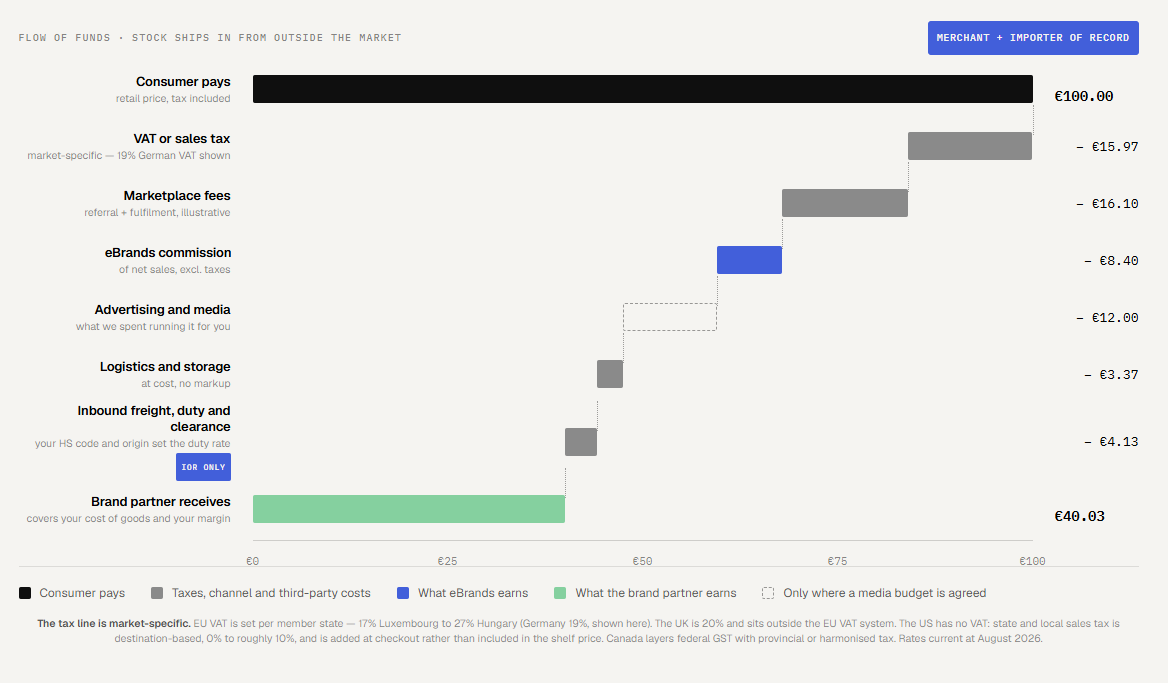
One bar exists here that the in-market chart does not have — inbound freight, duty and clearance, €4.13 per unit — so the partner receives €40.03 instead of €44.16. Import VAT is not in the chart on purpose: we pay it at the border and recover it, so it moves our cash, not yours. The exposure to plan for is unsold stock — returned or disposed of, with that freight recharged at cost.
Running this yourself is a fixed cost. - Running it with us is a variable one.
The commission is not an extra line on top of your operation. It stands in for the operation you would otherwise have to build, staff and pay for before you know whether the market works.
Alone, it is a fixed cost
Committed in advance, in every market, before a single unit sells — and it does not scale back down if a market underperforms.
With us, it is variable
The commission only exists on sales that happened. At healthy volumes the channel fee is marginal against what the channels return.
Costs you carry every month, sold or not
One variable line, and one small fixed one
The comparison that matters is not 7-10% versus zero — it is 7-10% versus what standing this up yourself costs. A brand adding markets alone commits to that cost base in advance, in every market, before the first sale. The commission scales with revenue instead, so the cost of being in a market arrives only once the market is paying for itself.
Running this yourself is a fixed cost. - Running it with us is a variable one.
The commission is not an extra line on top of your operation. It stands in for the operation you would otherwise have to build, staff and pay for before you know whether the market works.
Alone, it is a fixed cost
Committed in advance, in every market, before a single unit sells — and it does not scale back down if a market underperforms.
With us, it is variable
The commission only exists on sales that happened. At healthy volumes the channel fee is marginal against what the channels return.
Costs you carry every month, sold or not
One variable line, and one small fixed one
The comparison that matters is not 7-10% versus zero — it is 7-10% versus what standing this up yourself costs. A brand adding markets alone commits to that cost base in advance, in every market, before the first sale. The commission scales with revenue instead, so the cost of being in a market arrives only once the market is paying for itself.
You keep the brand. We take the legal and operational load.
No local entity, no VAT registration, no compliance stack in the target market.
Brand partner
Owns the brand and the upside
eBrands
Is the seller and the importer
You keep the brand. We take the legal and operational load.
No local entity, no VAT registration, no compliance stack in the target market.
Brand partner
Owns the brand and the upside
eBrands
Is the seller and the importer
The model only works if it works for both of us
An agency bills for effort and gets paid whether the channel works or not. We are paid a share of what sells, so a channel that underperforms costs us too. That is deliberate.
Freight, duty, storage, fulfilment and media are recharged at what they cost us, with no markup. We run the media on your channels, you approve the budget, and you see exactly what was spent. No commission is taken on media or on influencer and creator spend — none of it is net sales, so none of it enters the base.
The monthly channel fee covers the fixed cost of actually running each channel, so the work is properly staffed from launch instead of underinvested until volume shows up.
The model only works if it works for both of us
An agency bills for effort and gets paid whether the channel works or not. We are paid a share of what sells, so a channel that underperforms costs us too. That is deliberate.
Freight, duty, storage, fulfilment and media are recharged at what they cost us, with no markup. We run the media on your channels, you approve the budget, and you see exactly what was spent. No commission is taken on media or on influencer and creator spend — none of it is net sales, so none of it enters the base.
The monthly channel fee covers the fixed cost of actually running each channel, so the work is properly staffed from launch instead of underinvested until volume shows up.
Four lines, no surprises
Four lines, no surprises
The things brands ask us first
The things brands ask us first
Who this works for
The audience is there and growing faster than the operation behind it. The team is small, and the next hire the expansion demands is a compliance or logistics one, not another marketer.
You've seen what happens to pricing and positioning once someone else owns the route to the customer. Or your D2C core is solid and the growth is now in marketplaces you don't operate.
Same price, same positioning, everywhere you sell, including the channels that came along after your org chart did. TikTok Shop is the usual one.
ANSWR Beauty: five channels, no new headcount
Year one was Amazon US alone. Since then ANSWR has added their own D2C store, TikTok Shop, Target, Walmart.com and the UK, all running under our seller accounts. Their team makes the brand, the product and every piece of the TikTok content. We run the seller side of each channel: accounts, listings, orders, fulfilment, returns, and the tax and compliance behind every sale.