Payment System

Sell in person, anywhere. Legally.

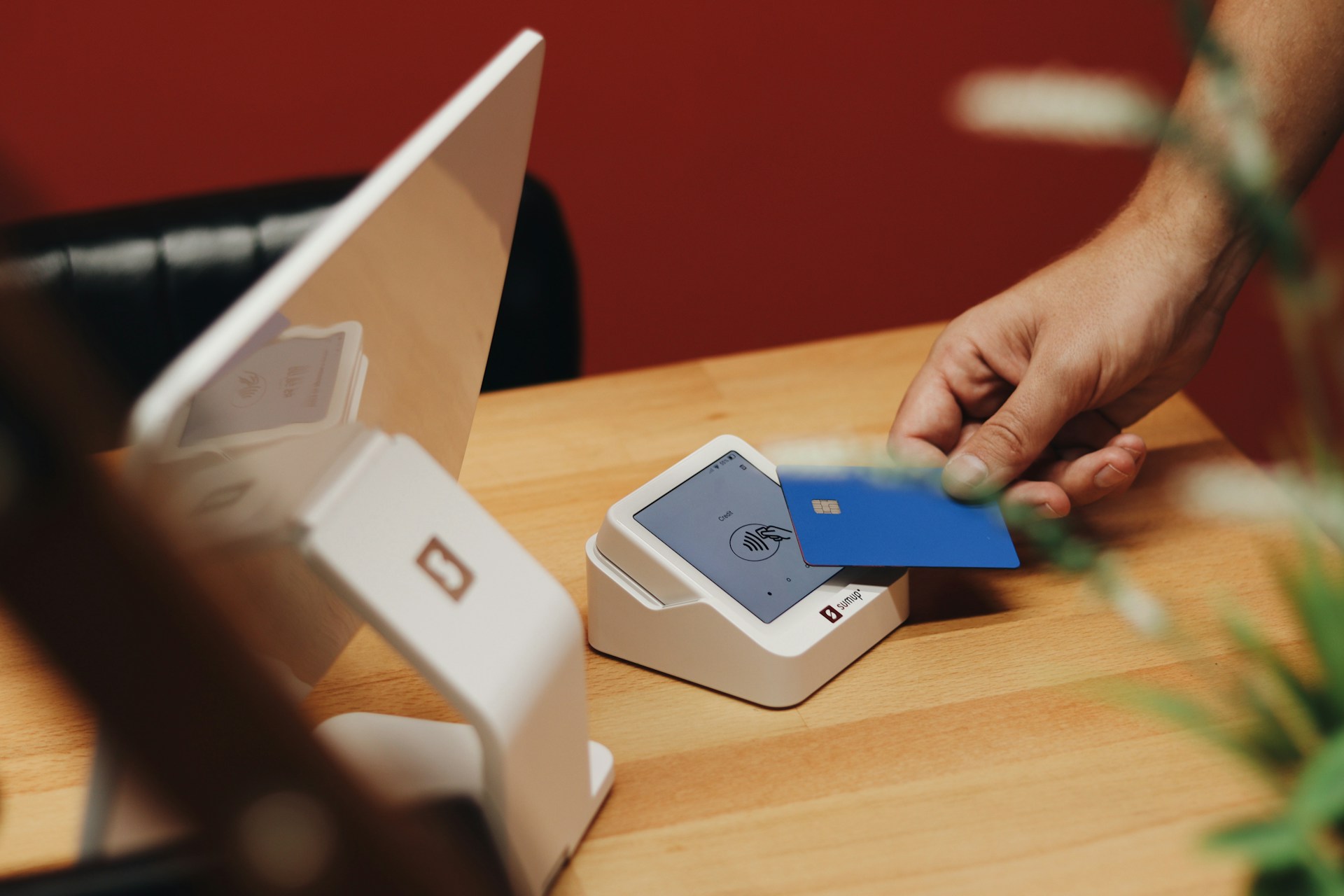
Pop-ups, trade fairs, in-store events, permanent retail — eBrands provides the compliant point-of-sale layer for selling face-to-face in foreign markets. The till runs on Shopify POS or SumUp; the VAT registration, fiscal certification, and legal-seller status run on us.


Talk to an expert
Robin Bade
Erika ottela photo
Jonne Välilä
Antti Moilanen
Need help?
Our experts will assist you.

Why in-person selling is back on every brand's roadmap

Digital-first brands are rediscovering physical retail — and for good reasons. In-person selling does things no ad campaign can.

Customers touch the product

Conversion rates at pop-ups and events routinely beat online, because the biggest objection — "what is it actually like?" — disappears at the table.

Retail proves demand to retailers

A successful pop-up or shop-in-shop is the strongest pitch a brand can make to buyers at chains like Douglas, Clas Ohlson, or Stadium. It's a market test with revenue attached.

Margin without the marketplace fee

Direct in-person sales carry no marketplace commission and no rising CAC. For premium brands, an event weekend can outperform a month of paid traffic.

The brand becomes real

Face-to-face contact builds the loyalty that shows up later as returning-customer rate — the same metric that drove Luonkos's D2C profitability with eBrands.

The till is the easy part. The law is not.

There are four ways to taModern POS software is genuinely excellent. Shopify POS rings up a sale, takes a card, syncs inventory back to the catalogue that powers the webshop. Pair a SumUp reader and a brand running a stand in another country feels like the problem is solved. The trouble is that the software solves the commerce problem brilliantly and the compliance problem not at all — and in cross-border retail, the compliance problem is the one that gets brands fined.ake a brand international. Only one gives you the balance of control, speed, and scale — without the overhead.

What POS software handles well

The software layer
Transactions & checkout
Ringing up items, discounts, split payments, cash and card.
Inventory sync
One catalogue and stock count across online and in-person — a unit sold at the stand drops from available inventory everywhere.
Hardware flexibility
Shopify readers, SumUp, and other connected terminals — the physical till assembled to suit the event.
Unified reporting
In-person and online sales in one commercial view.

What no POS app handles abroad

The compliance layer
Legal-seller status
Selling in person abroad generally creates a local taxable presence — VAT registration is required regardless of turnover. The app processes the sale; it doesn't register you, file the return, or carry the liability.
Fiscal certification
Italy's telematic recorder (RT), Germany's TSE, France's accredited software (self-certification ends Sept 2026), Portugal's AT certification. "Running Shopify POS" satisfies none of these automatically.
Country-compliant receipts
Fiscalised markets require QR codes, fiscal identifiers, or sequential codes from a certified process. A standard POS receipt is not the same legal document.
2026 mandates & customs
Italy's POS–RT link, Germany's ELSTER device registration — plus getting stock there at all: customs, duties, Importer of Record. All upstream of the till.
The mental model: think of the POS app as the till and the catalogue. It records what was sold and moves the money. It does not — and was never designed to — make you the legal seller in a foreign country or satisfy that country's tax-authority requirements for how a sale is certified and reported.

Two layers,
one working setup

Use the POS software — it's the right tool. Just don't mistake it for the compliance layer. Cross-border retail needs both, and the layer that makes the sale legal is the one no app store sells.
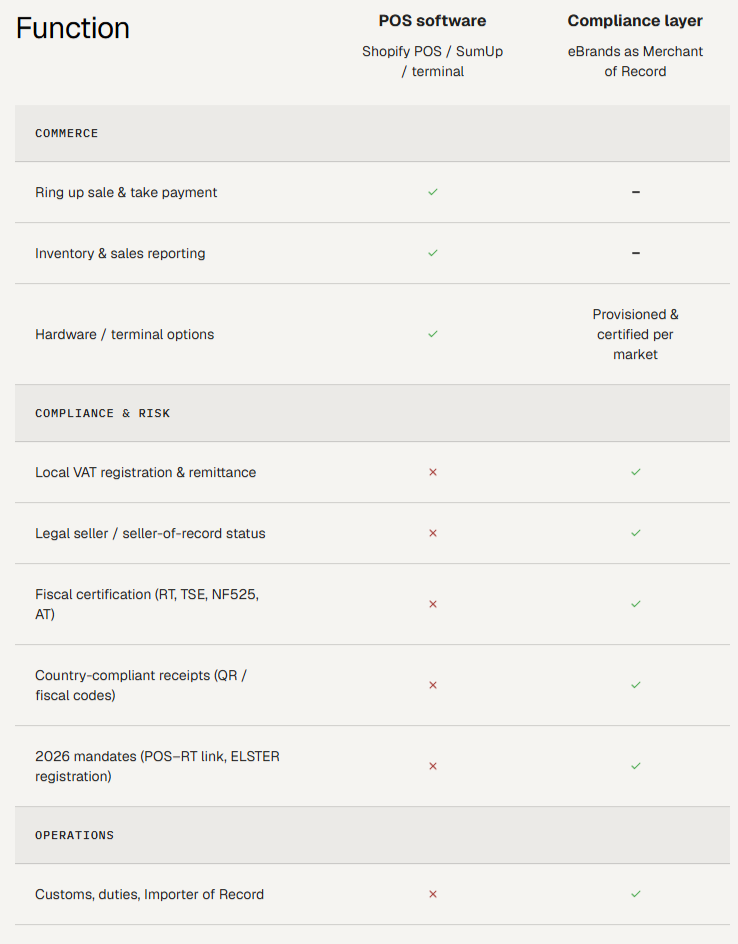
Function
POS software
Shopify POS / SumUp / terminal
Compliance layer
eBrands as Merchant of Record
Commerce
Ring up sale & take payment
Inventory & sales reporting
Hardware / terminal options
Provisioned & certified per market
Compliance & risk
Local VAT registration & remittance
Legal seller / seller-of-record status
Fiscal certification (RT, TSE, NF525, AT)
Country-compliant receipts (QR / fiscal codes)
2026 mandates (POS–RT link, ELSTER registration)
Operations
Customs, duties, Importer of Record
POS ebrands table

How compliant POS works with eBrands

In the eBrands retail model, the point-of-sale system, the payment terminal, and the market-specific compliance apps all live on the operator's store and accounts — ours. Your products, prices, and stock sync in. Staff tap on Shopify POS or SumUp exactly as they would anywhere — but every sale lands in an environment where legal-seller status, VAT treatment, fiscal certification, and receipt rules for that country are already handled. Built once per market, reused for every brand and every event.

Scope the market & event

Tell us where you're selling — a Berlin pop-up, a Milan trade fair, a Paris shop-in-shop. We map the fiscal requirements for that specific country.

Learn
Scope defined
Sync your catalogue

Products, prices, and stock flow into the eBrands operator environment. Inventory ships once to our fulfillment network; we act as Importer of Record for customs and duties.

Catalog
Customs cleared
Compliant till, provisioned

We provide the terminal setup certified for that market — receipt formatting, fiscal codes, device registration, and the 2026 connection mandates pre-configured.

Certified
Registered
Sell — and see it in Apollo

Every in-person transaction flows into Apollo Intelligence alongside Amazon, D2C, and marketplace data — one view of sell-through, inventory, and P&L.

2–4 weeks live

One inventory. Every channel — including the physical one.

Powered by Apollo

➜ A unit sold at a Helsinki pop-up updates the same inventory that feeds Amazon DE.

➜ In-person sales data sits next to marketplace and D2C data in Apollo — SKU-level profitability included.

➜ Successful events become the evidence base for retail expansion — the path Lux took, doubling its retail channel with eBrands

➜ No local entity, no per-country VAT projects, no fiscal-certification homework for your team

Contact Us
Channel Performance — Live
Amazon US
$48,210
Shopify D2C
$31,400
Walmart
$22,850
Pop-up
$14,320
TikTok Shop
$5,783
Total MTD
$122,563 ↑

Common questions about compliant POS

Can I use my existing Shopify POS setup with eBrands?

Yes — Shopify POS is the right software and we work with it, along with SumUp and other connected terminals. What changes is where it runs: the till operates on the eBrands operator environment, where the legal-seller status, VAT registration, and fiscal certification for the market are already in place. Your catalogue and stock sync in.

Do I need a local company or VAT number to sell at a pop-up in Europe?

Not with eBrands. Selling in person normally creates a local taxable presence requiring VAT registration regardless of turnover. As your Merchant of Record, eBrands is the legal seller for the transaction — we hold the registrations, collect the tax, and file the returns. You never set up a local entity.

What is fiscal certification and does it apply to me?

Several European countries require that the system issuing receipts is certified by the national tax authority — Italy's telematic recorder, Germany's TSE, France's accredited software, Portugal's AT certification. If you sell in person in these markets, it applies to you, and a standard POS app alone does not satisfy it. eBrands provisions the certified configuration per market.

What changed in 2026?

Two big ones: Italy now requires payment terminals to be linked to the telematic recorder through a government portal, with per-device fines for non-compliance, and Germany requires POS devices to be registered with the tax authority via ELSTER. France's self-certification route for POS software also ends in September 2026. These obligations sit entirely outside the POS app.

Who gets my inventory to the event?

eBrands acts as Importer of Record: customs clearance, duty payment, HS classification, and trade compliance. You ship inventory once to our fulfillment network; we handle importing into every active market — including stock for retail events.

Do in-person sales show up in my reporting?

Yes — every POS transaction flows into Apollo Intelligence alongside your online channels: sell-through per event, inventory movement, and SKU-level profitability in one live view, instead of a separate spreadsheet for the physical channel.

Do I keep ownership of my brand and inventory?

Always. As with every eBrands partnership, you retain 100% ownership of your brand, IP, pricing decisions, and inventory. eBrands operates as the legal seller in front of the customer; the brand stays fully yours.

What does compliant POS cost?

It follows the standard eBrands model: a monthly retainer, a performance commission on order value, and one-time setup per market — with operational costs passed through at cost, zero markup. Because the fiscal configuration is built once on the operator side and reused across brands, a single pop-up doesn't carry the per-market compliance setup it would cost to do alone.

Ready to go global?


Let us show you how eBrands can take your brand to every market that matters.

Contact us

Let's connect
Connect with us though our form
Send us an email
General inquiries and partnerships
Give us feedback or suggestions
Message us

Book a meeting

Talk to an expert
Get a custom growth plan for your brand
Walk through your market entry strategy
See how our platform fits your setup
On-the-spot expert advice