How the eBrands Model Works: From Onboarding to Global Revenue

You've decided to go global. Maybe you've been talking to distributors. Maybe you've looked at setting up your own Amazon Seller Central account in three countries. Maybe you've tried doing it yourself and hit a wall of VAT registrations, customs paperwork, and warehouse contracts.
Now you're looking at eBrands and asking the obvious question: how does it actually work? What happens between signing up and having products selling in multiple markets?
This is a step-by-step walkthrough of the whole process. No vague promises, just the mechanics.
Phase 1: Discovery and Scoping
Everything starts with a conversation, and it's more commercial than it is salesy.
We need to understand your brand, your products, and your ambitions in concrete terms. What are you selling? What markets are you in today? What markets do you want to be in? What channels are you already on? What does your fulfilment setup look like? What's your margin structure?
Our team analyses your product category, competitive landscape, and market potential. We look at which channels actually make sense for your brand. Not every brand should be on every marketplace, and we'll say that upfront if it applies.
The output is a clear picture: which markets, which channels, what the expected economics look like, and what the service scope would be. This usually takes one to two weeks from first meeting.
Phase 2: Product Data and Commercial Proposal
Once we agree on the scope, you submit your product data. Product catalogue, pricing, packaging specs, and whatever certifications or compliance documentation you already have.
We run that data through our commercial model. This isn't a rough estimate. We calculate estimated freight and customs costs per market, warehousing and fulfilment costs based on your product dimensions and expected volume, marketplace and channel fees, duty and tariff exposure, and the unit economics of each product in each market.
The result is a commercial proposal that shows the partnership financials in detail. Setup fee, monthly management fee, commission rate, projected cost structure per unit. No hidden fees, no surprises six months in.
A few days from receiving complete product data to delivering the proposal.
Phase 3: Compliance and Regulatory Clearance
This is where most brands get stuck doing it themselves. It's also where eBrands takes on the heaviest lift.
Before we sell your products in a new market, they need to be compliant with local regulations. What that means depends on where you're going.
For the EU, that's CE marking, product safety directives, packaging compliance, EPR registration, labelling in local languages. For the US, it could be FDA registration, FCC compliance for electronics, Prop 65, CPSC safety standards. For the UK, post-Brexit UKCA marking and UK-specific labelling requirements.
eBrands runs your product data against the regulatory requirements of each target market. We identify what's already good, what needs minor adjustments (adding a language label, for example), and what requires more work.
Because eBrands acts as both the Merchant of Record and the Importer of Record, we carry the legal responsibility. This isn't advisory. We take on the liability, which is why we take the clearance process seriously.
Timeline varies. Simple consumer goods can clear in days. Products with specific regulatory requirements (health, electronics, children's products) may take a couple of weeks. We run this in parallel with other phases so it doesn't bottleneck the whole process.
Phase 4: Contract and Legal Setup
Once the commercial proposal is agreed and compliance is cleared, we formalise everything.
The contract covers commercial terms, scope of services, operational responsibilities, brand guidelines and pricing authority, and settlement mechanics.
The structural point that matters: eBrands becomes the Merchant of Record. We are the legal seller of your products in each market. We handle customer-facing transactions, collect payments, manage sales tax and VAT, and take responsibility for compliance.
Your brand remains your brand. You own the IP, the trademarks, the strategic direction. You set pricing. You approve positioning. eBrands is the operating engine.
Standard agreements take a few days. Complex multi-market scopes might take a week if there's back-and-forth on specific terms.
Phase 5: Technical Integration and Onboarding
This is where the operational work happens. Our tech team connects your product data to Apollo, our central platform that powers inventory management, order routing, channel listings, financial reporting, and analytics.
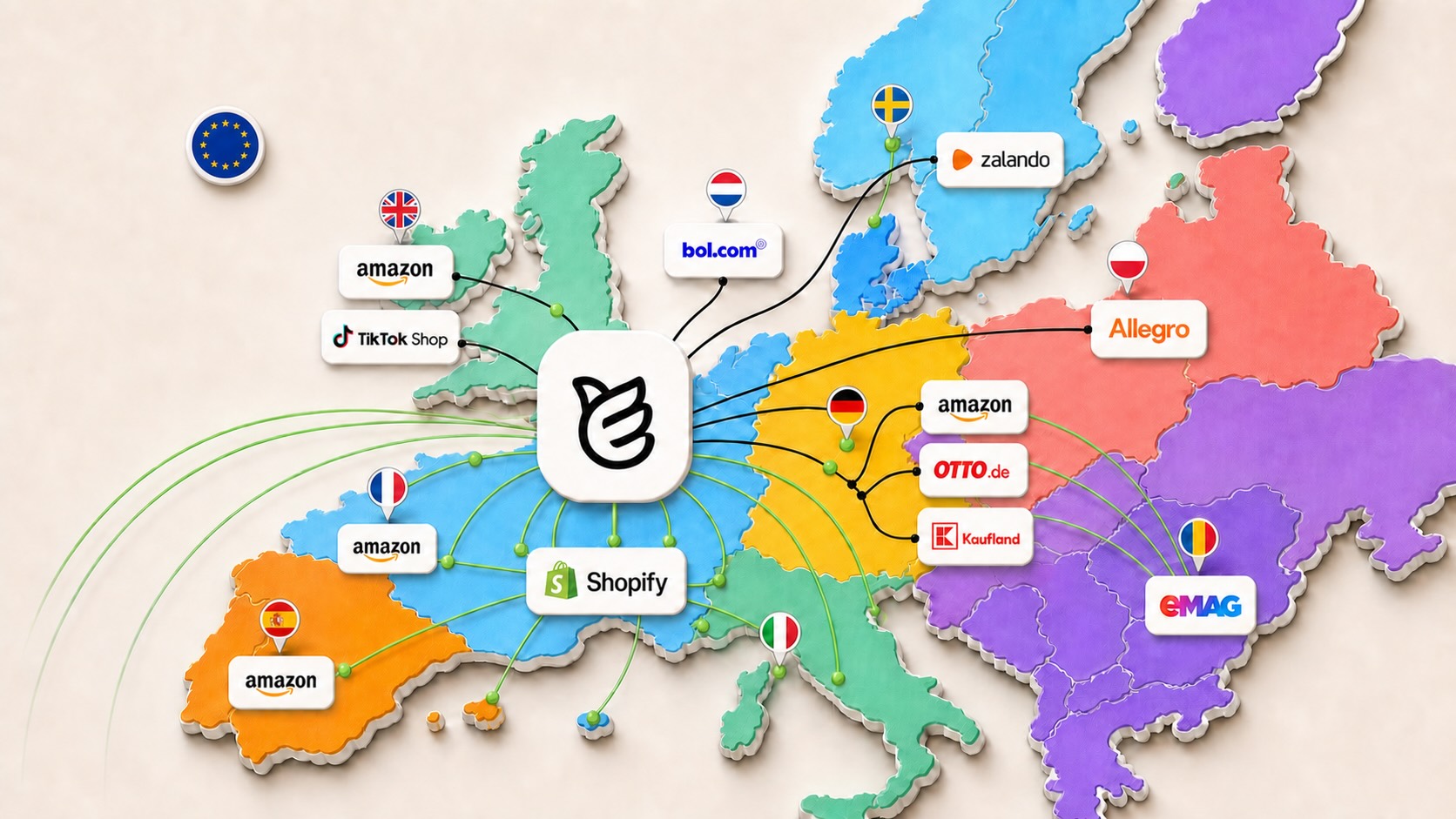
During onboarding, product listings get created for every channel and marketplace in every target market. Titles, descriptions, images, keywords, A+ content for Amazon, all tailored per platform, not copy-pasted. Inventory gets transferred to our fulfilment network across the US, EU, and UK. Channel accounts get configured, Amazon Seller Central, Shopify storefronts, marketplace accounts, retail EDI connections, everything connecting back to Apollo. Advertising infrastructure gets set up with campaign structures, keyword strategies, budget allocation. Customer service gets configured in local languages.
The full onboarding typically takes two to four weeks. Brands with simple catalogues and existing compliance docs can go faster. Larger catalogues take a bit longer.
Phase 6: Launch
Products go live on marketplaces. D2C storefronts are running. Advertising starts. Orders flow into the fulfilment network. Returns and customer service are handled by our teams.
But launch is the beginning of active management, not the end of a project. In the first 30 to 60 days, our teams closely monitor sell-through rates, advertising performance, inventory velocity, customer feedback, and competitive positioning.
Having one operating partner across all channels matters most in this phase. If Amazon sales spike, we adjust D2C ad spend and inventory allocation the same day. If a product underperforms in one market, we shift resources to where it's gaining traction. One team sees the whole picture, so decisions happen in hours.
Phase 7: Ongoing Operations and Growth
After launch stabilises, the partnership shifts into an ongoing rhythm.
Monthly sales statements arrive within 30 days after month-end with a full breakdown: gross sales, returns, costs, commission, net payout. You see exactly what sold, where, at what cost, and what you earned.
Net proceeds get paid based on sell-through. One payout covering all markets and channels. No chasing five different invoices from five partners.
Regular performance reviews happen with your account team, covering sales versus plan, channel analytics, advertising ROI, inventory health, and what to focus on next, whether that's launching a new product, entering a new market, or tweaking the channel mix.
Apollo gives you real-time visibility anytime you want it. You don't need to wait for a monthly report to know how your brand is performing.
A Concrete Example
A beauty brand comes to eBrands doing €3M in their home market, selling through their own website and a few local retailers. They want to scale into the US and UK.
Week 1 to 2, discovery and scoping. We recommend starting with Amazon US, Amazon UK, and localised Shopify stores for both markets.
Week 2 to 3, product data submitted, commercial proposal delivered.
Week 3 to 4, compliance review. Minor label adjustments needed for the US (ingredient listing format) and UK (UKCA marking). We handle both.
Week 4, contract signed.
Week 4 to 7, technical onboarding. Listings created, inventory shipped, advertising configured.
Week 7 to 8, go live. Products selling on Amazon in two countries, D2C in two countries, with advertising running and customer service active.
Month 3, first review. Amazon US is outperforming projections. UK D2C needs a creative refresh. We reallocate budget and brief the content team.
Month 6, the brand adds Germany and Zalando. No new partners needed. No new contracts. Just an expansion of scope within the existing partnership.
That's the timeline. Conversation to global revenue in about two months. No local entities, no hiring, no compliance headaches.
Where This Leaves Us
We built this model because we saw what the alternative looked like. Brands spending a year trying to set up operations in one country, burning cash on consultants and contractors, and still not selling anything.
The eBrands model collapses that timeline from months to weeks. Not by cutting corners, but because the infrastructure already exists. The warehouses are running. The marketplace connections are live. The compliance frameworks are in place.
When you partner with eBrands, you're plugging into a commerce engine that's already operating at scale. You bring the brand, we bring the global infrastructure. That's the arrangement, and it works.

“ We are dedicated to assisting you; please contact us for any information or inquiries you may have. ”

.jpg)
.jpg)
.jpg)


















%2520(1).png)