Which Expansion Model Is Right for Your Brand?

We've watched hundreds of ambitious brands reach the same crossroads. They've dominated their home market, their products are flying off shelves, and now they face the biggest question:
How do we expand globally without losing control of our brand?
This isn't easy. Expand too slowly and competitors beat you to new markets. Expand recklessly and you lose what made your brand special. The truth is there are four main approaches and each with different costs, speeds, and trade-offs.
In this article, we're breaking down all four so you can choose the one that fits your brand.
The Core Question: What Are You Willing to Trade?
Here's something most brands don't think about: every expansion path requires trade-offs. With the right partner, you can have both speed and control. Capital efficiency or maximum profit. Operational simplicity or complete ownership. Pick two. The art of scaling globally is choosing which trade-offs align with your priorities right now. So before we dive into the four models, ask yourself: What matters most to us? Speed to market? Protecting our brand? Keeping cash in the bank? Your answer will point you toward the right path.
Model 1: The Agent Model :Your Partner on the Ground
What It Is
You hire a person or small team in a new country to represent your brand. They're your eyes and ears on the ground, focused purely on sales, not full execution. You make the decisions. They find buyers, manage retailer relationships, and grow your revenue.
How It Works
- You define the strategy: "I want premium positioning in Germany"
- They find retailers and manage relationships
- You approve pricing and positioning
- They pay them 10-20% commission on sales
- You get direct feedback about what's working
Advantages and disadvantages
You maintain full control over every decision made in your business, with only commission-based payments required upfront, keeping costs low. This relationship with the market provides immediate feedback through your agent, allowing you to understand customer needs and market dynamics , keeping in mind that the agent owns the retailer relationships and acts as the intermediary.
The agent-based model creates significant risks including dependency on a single person whose departure could collapse your business. Scaling across multiple countries becomes difficult, while compliance, VAT, customs, and local legal responsibilities all remain with the brand as agents work purely for sales and do not manage any of these obligations. Additionally, successful agents typically demand equity or higher compensation, limiting your growth ceiling. Furthermore, agents work only for retailer and B2B sales they do not support or enable ecommerce, marketplaces, or D2C channels, making this model limited and out of step with today's market needs.
Model 2: The Distributor Model : Fast but Risky
What It Is
You sell your products to a distributor at a certain discount. They own the inventory, sell to retailers, set prices, and keep all the profit. Your job ends after that first sale.
How It Works
- You manufacture your product
- You sell to Distributor at €10 per unit (50% of retail price for example)
- Distributor buys inventory, you get paid immediately
- Distributor sells to retailers at whatever price they want
- You're done. They handle everything.
Advantages and Disadvantages [AM6]
The Distributor Model offers some clear benefits for speed. You get the fastest market entry you can be live in weeks instead of months. Upfront inventory purchase by the distributor reduces your stock risk, though payment terms can still range from 90 to 120 days depending on the agreement. You have zero operational responsibility since they handle everything: logistics, customer service, returns, compliance. And critically, you don't need to hire any staff or establish any presence in that country. It's the simplest model to execute from a logistical standpoint.
However, the disadvantages are severe and often overlooked. You lose complete control of your brand because the distributor decides everything : pricing, positioning, where it's sold, how it's marketed. This may lead to brand destruction through aggressive discounting. Your premium product ends up getting sold cheap on discount sites to move inventory fast. You get zero customer feedback because you have no direct relationship with buyers. Moreover, you don't know who's purchasing, what they think, or what they need. Most critically, once a distributor controls a market, you're trapped. Recovery is nearly impossible because they own all the retailer relationships, and you can't easily re-enter that market or rebuild your brand image once it's been damaged by discounting. Additionally, distributors work only for B2B and retail sales. They do not cover ecommerce, marketplaces, leaving a significant gap that is increasingly hard to ignore in today's market.
Model 3: The DIY Model : Full Control, Full Price Tag
What It Is
You build your own international operation from scratch. Hire teams, rent offices, manage logistics, handle compliance ; everything. You own it all. You also pay for it all.
How It Works
- Set up legal entity in new country
- Hire team: General Manager, Ops Lead, Marketer
- Rent office and warehouse
- Manage all operations: taxes, customer service, inventory, compliance
- Keep 100% profit (minus costs)
Advantages and Disadvantages
The DIY Model delivers genuine control and ownership benefits. You have complete control over every strategic decision from pricing, positioning, marketing to partnerships. You build direct relationships with your customers and see in real time what's working and what isn't. You keep 100% of the profits after operational costs, so as you scale, profitability multiplies. You're building a real, durable business in that market that's not dependent on anyone else and that's valuable for long-term brand building.
The disadvantages are what stop most brands from choosing this path. The capital required is massive. The road to profitability is long, with 18-36 months of burning cash being the normal timeline. The operations are incredibly complex because you're dealing with different tax systems, different labor laws, different compliance requirements in every single country. You need experienced people to run this furthermore you can't hire junior staff and expect them to figure it out. And there's a geographic disadvantage: if you're not physically there managing the operation, you're managing from a distance dealing with time zone issues, cultural differences, and not having your finger on the pulse of the actual market.
Model 4: The Merchant of Record (MoR) : Where eBrands Operates
What It Is
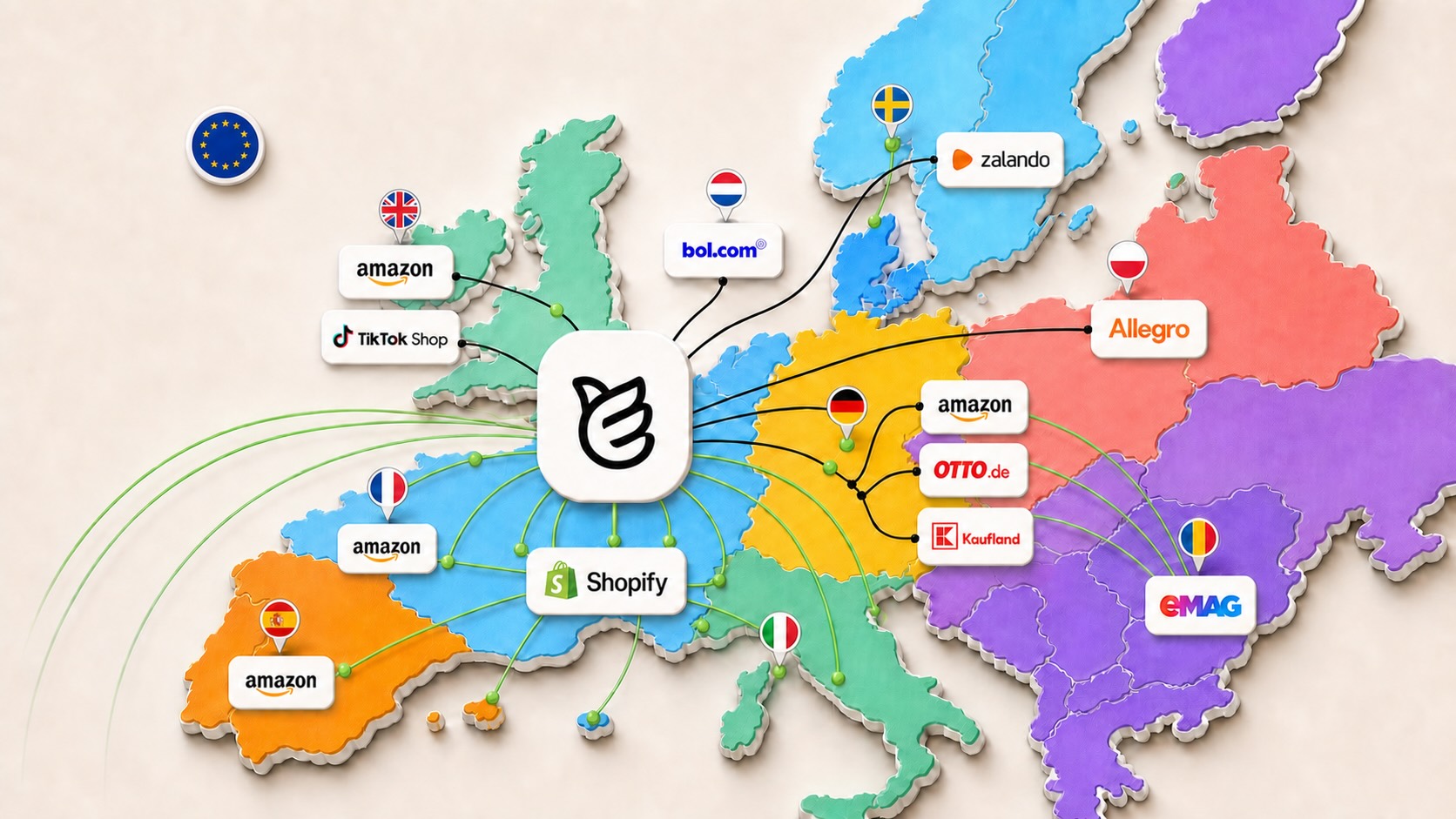
A partner (like eBrands) becomes the legal seller of your products in new markets. You keep strategic control. They handle all operations: taxes, logistics, compliance, customer service in local languages. It's the best of all worlds. This is the model eBrands was built to deliver.
How It Works
- You design and manufacture your product
- You provide stock to eBrands on consignment
- eBrands becomes the Merchant of Record (legally responsible for all sales)
- You decide: pricing strategy, brand positioning, marketing message
- eBrands handles: taxes in all countries of operations, warehousing, payments, compliance, customer service in local languages.
- You launch on marketplaces, D2C ecommerce, and social commerce within weeks through eBrands' infrastructure
Advantages and Disadvantages
The MoR Model (which is what eBrands specializes in) combines benefits from all other approaches and represents the modern solution to global expansion. You keep complete brand control. You set pricing and positioning, and eBrands executes your vision without diluting your strategy. You get unmatched speed to markets. Your capital investment is minimal. You get professional operations across every dimension: eBrands has logistics networks managing storage and shipping, compliance experts who know local laws inside and out, and customer service teams operating in local languages. You don't need to hire or manage international teams across different labor law systems. Your risk is remarkably low since you only pay commission on sales that actually happen. And you can launch in multiple countries simultaneously without multiplying your costs or operational burden; eBrands' infrastructure is already built and ready. This is why forward-thinking brands choose eBrands.
The only real trade-off is paying commission on every sale, which is the cost of having eBrands absorb all the operational complexity, regulatory risk, and infrastructure costs that would otherwise fall entirely on you. It's a remarkably fair exchange when you consider you're gaining immediate market access, professional compliance handling, and operational scale that would take you years and millions to build alone.
eBrands' Take
At eBrands, we see this expansion challenge as a defining moment; not a problem for tomorrow, but a reality for today. The old models : Agent, Distributor, DIY were built for a different era. They forced brands to choose between speed and control, between capital efficiency and operational excellence.
We knew there had to be a better way.
That's why we built the Merchant of Record model. Not as just another option, but as the solution that changes how ambitious brands think about global expansion. We see brands reaching their home market ceiling every day. We see them staring at impossible choices: slow and steady with an agent, risky and diluting with a distributor, or expensive and complex with DIY. We knew they deserved better.
The truth is, global expansion has fundamentally changed. It's no longer about having the biggest team or the deepest pockets. It's about having the right partner... one who understands your brand as deeply as you do, who can move at internet speed, and who absorbs the operational complexity so you can focus on what you do best: building amazing products.
That's the eBrands difference.

“ We are dedicated to assisting you; please contact us for any information or inquiries you may have. ”

.jpg)
.jpg)
.jpg)















%2520(1).png)