What Is EPR? Extended Producer Responsibility for Sellers in Europe

On 12 August 2026, a lot of European product listings went dark without warning. The date marked the point when most provisions of the EU's new Packaging and Packaging Waste Regulation took effect, extending packaging registration duties across every member state rather than the handful that had been enforcing them, and marketplaces enforced it the way they always do: by deactivating listings that could not show a number. EPR is the least glamorous obligation in European ecommerce and one of the most disruptive, because it is not one law you comply with once. It is a separate registration in every country, for every product stream, with no volume threshold to hide under.
The short answer: EPR (Extended Producer Responsibility) makes whoever first places a product on a national market financially responsible for its end-of-life collection and recycling, which means registering with that country's scheme, reporting volumes, and paying fees.
Key takeaways
- There is no single EU EPR registry. You register separately in each country where you sell.
- Most schemes have no minimum volume. Germany's LUCID applies from the first packaged item sold.
- One product can trigger several streams at once: a speaker means packaging, WEEE, and batteries, each with its own registration.
- PPWR provisions applying from 12 August 2026 widened packaging obligations across the EU and require an authorised representative per member state for non-established sellers.
- Marketplaces enforce per stream and per country. A missing number deactivates the listing in that market, usually without a grace period.
What is EPR?
Extended Producer Responsibility is the policy principle that the company placing a product on a market should pay for what happens to it after the consumer is finished with it. Ship a product in a cardboard box with plastic wrap, and you contribute to the cost of collecting and processing that box and that wrap when it goes in the bin.
In practice, that principle turns into four obligations per market. You register with the national producer register and receive a producer identification number. You contract with an approved Producer Responsibility Organisation, the body that runs or finances the collection system. You report the volumes and materials you placed on that market, usually annually with some schemes requiring more frequent filings. And you pay fees calculated on those volumes, increasingly adjusted by how recyclable your materials are, a mechanism called eco-modulation that makes badly designed packaging cost more.
The definition of "producer" is where sellers get caught. It is not only manufacturers. For imported goods it is generally the party that first places the goods on that national market, which for a brand selling direct into Germany from outside the EU is the brand itself, not the factory that made the product and not the customer who bought it.
Which product streams does EPR cover?
Packaging is the stream that affects every physical product, since everything ships in something. But it is one of several, and they stack.
The established streams are packaging, electrical and electronic equipment (WEEE), and batteries. Newer or expanding schemes cover textiles, furniture, tyres, and single-use plastics, with France running the widest range in the EU. As the compliance specialists at Complir note, exact categories and fee structures are set by each member state, so the same product can carry different obligations from one EU market to the next.
The stacking is what surprises people. A Bluetooth speaker sold in France triggers packaging, WEEE, and batteries, three separate registrations with three separate PROs. A t-shirt triggers packaging and textiles. Marketplace compliance checks run per stream rather than globally, so holding a valid packaging number while missing the battery registration still gets the listing pulled.

How does EPR work country by country?
There is no EU-wide registration. Each member state runs its own register, its own PROs, and its own identification number format.
Amazon's compliance workflow makes the pattern concrete. AVASK's guidance for sellers lists exactly what Seller Central expects you to upload: the LUCID number for German packaging, the Stiftung EAR number for German WEEE, the IDU for France, or RPD confirmation for the UK. Four numbers, four systems, and that is before Italy, Spain, and Austria. If you sell across Amazon's European marketplaces, the registration count multiplies quickly.
What changed on 12 August 2026?
Regulation (EU) 2025/40, the Packaging and Packaging Waste Regulation, replaced the old Packaging Directive. It entered into force in February 2025, and most of its provisions became applicable on 12 August 2026. Three consequences matter for sellers.
Packaging obligations now extend across the EU rather than concentrating in the countries that enforced early. Where a seller previously worried about Germany and France, the practical scope is now every member state they ship to. Non-established sellers must appoint an authorised representative per member state for packaging, which is a formal legal appointment rather than a service subscription. And reporting is being standardised toward a common dataset, which will eventually reduce the administrative variation between countries, though not the number of registrations.
France moved in parallel, making the appointment of a mandataire REP compulsory by written mandate from 10 July 2026, with the representative subrogated into the obligations it accepts. The direction across Europe is the same: authorities want a legally accountable party inside the EU for every producer selling into it, exactly as GPSR does for product safety.
The enforcement date was hard rather than phased. Sellers who reached 12 August without numbers in place did not get warnings; they got deactivated listings in the countries where the number was missing. If you are reading this having already lost listings, the fix is registration, not appeal.

How do you register for EPR?
The sequence is consistent across markets, and the timing is the part worth planning around.
- Audit your catalogue by stream and by country. For each product, list every stream it touches (packaging, WEEE, batteries, textiles) and every country you sell into. The output is a matrix, and its size is usually the first surprise.
- Capture SKU-level packaging data. Material types and weights per SKU, since that is what fees are calculated on. Most brands discover their ERP does not hold this, and building it is the longest task in the project.
- Appoint an authorised representative where you have no local entity. Germany's Bevollmächtigter under the packaging act, France's mandataire REP, and the equivalents elsewhere. This is a written mandate, not a form.
- Register with the national register and contract a PRO per stream. One filing per stream per country, with the representative handling the dossier in your name where one is appointed.
- Wait for the identification number to publish. This is the step that catches launch plans: EPR Representative puts France at roughly two to three weeks per stream on SYDEREP, and until a number is published, marketplaces will not accept it.
- Upload the numbers to every sales channel. In Amazon Seller Central this sits under Compliance, and the same numbers belong on your invoices and your own storefront where required.
- Report and pay on schedule. EPR is annual, not one-off. Volumes change, fees follow, and unreported quantities surface in audits.
What happens if you ignore EPR?
The commercial consequence usually arrives before the legal one. Marketplaces deactivate listings in the affected country, which is immediate revenue loss in a market you have already spent to enter. Authorities can require registration retroactively, and back-fees for volumes already placed on the market are a genuine exposure rather than a theoretical one. Fines vary by member state and are set nationally, and in the meantime your competitors keep selling.
There is a subtler cost too. Retail buyers and larger marketplace partners increasingly ask for registration numbers during onboarding, so missing registrations quietly disqualify you from channels before anyone tells you why.
How EPR fits the rest of European market entry
EPR rarely arrives alone. The same decision to sell into Europe triggers VAT registration or OSS filings, customs and importer-of-record establishment, and product safety obligations under GPSR, which requires an EU-based Responsible Person for every product from a non-EU manufacturer. We covered that regime in our guide to GPSR and what it requires from sellers, and EPR is its commercial twin: GPSR asks who is accountable for the product's safety, EPR asks who pays for its packaging's disposal. Both want an accountable party established inside the EU, and the country-level variations we track in our EU compliance map apply to both.
The reason brands underestimate this is that each individual step is small. One registration is straightforward. The problem is multiplication: streams times countries times annual reporting, maintained indefinitely while the rules keep moving, with the WEEE framework itself under revision and further PPWR provisions still landing. Our overview of what is changing in EU market entry covers the wider picture.
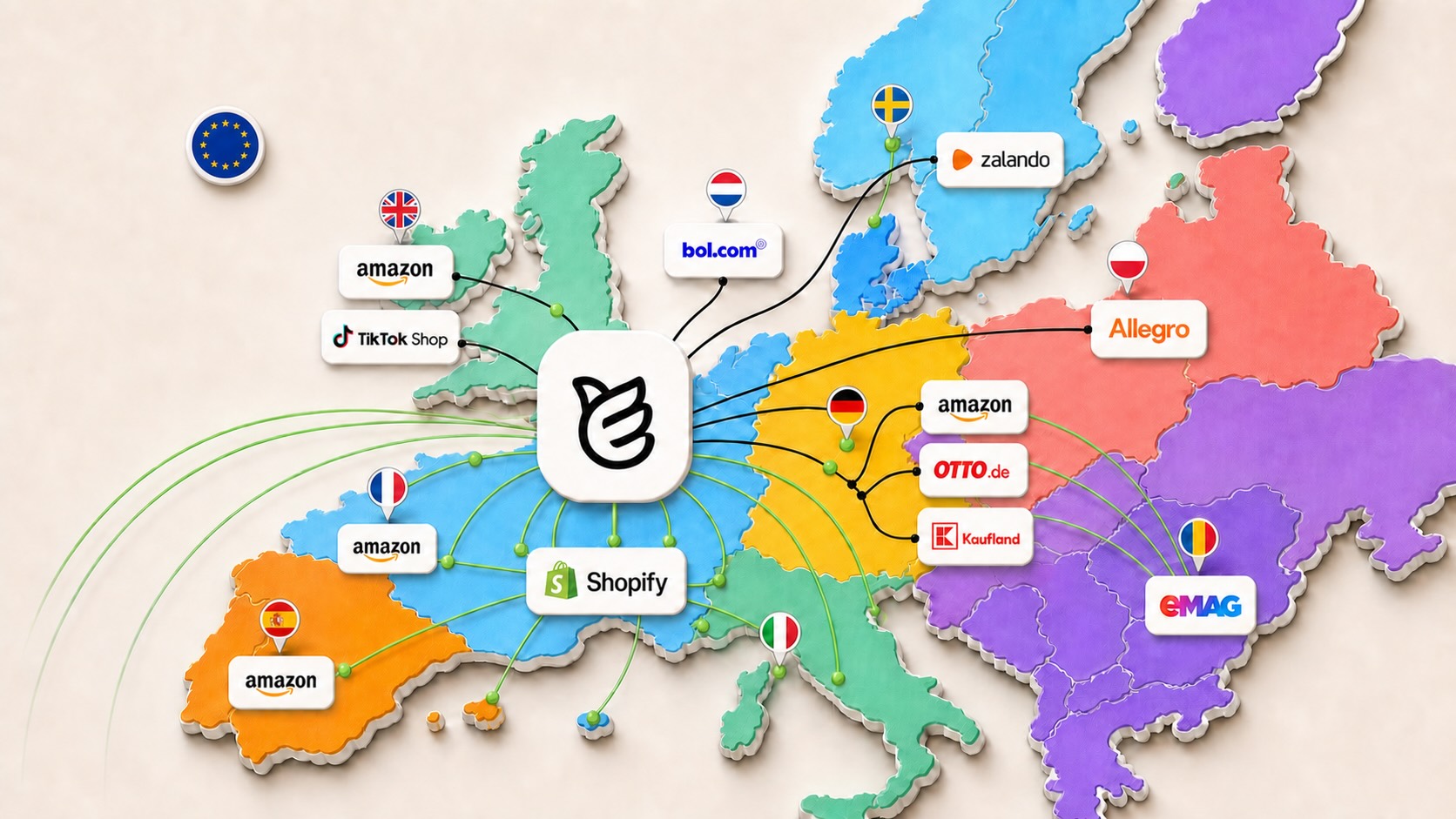
This is precisely the layer eBrands takes on. Our EU entities act as Importer of Record and Merchant of Record in each market, and we handle VAT, EPR, and regulatory compliance as part of operating your channels, which is how brands sell across Europe without setting up distributors or legal entities in each country. Your products stay live because the registrations behind them are already in place and maintained. If listings went down this month and you are working out how many registrations you actually need, our team can map it against the markets you sell in.
Frequently asked questions
Is there a minimum volume before EPR applies?
Generally no. Germany's LUCID applies from the very first packaged item placed on the market, and most EU schemes work the same way. Small sellers are not exempt.
Do I need to register for EPR in every EU country?
Yes, in every country where you place goods on the market. There is no single EU registry, and each member state runs its own register, PROs, and identification numbers.
Can my GPSR Responsible Person also cover EPR?
Not automatically. They are separate legal roles under separate regulations. Some providers offer both, but the mandate must cover packaging EPR explicitly and in writing.
What is a PRO?
A Producer Responsibility Organisation, the body that manages or finances collection and recycling on behalf of producers. In most EU countries you must contract with an approved PRO and report your volumes to it periodically.
What happens to my listings if I do not have an EPR number?
Marketplaces deactivate them in the country where the number is missing, and enforcement runs per stream, so a valid packaging registration will not save a listing that also needs a battery or WEEE number.

“ We are dedicated to assisting you; please contact us for any information or inquiries you may have. ”







.jpg)









.jpeg)