Amazon Brand Protection: Stopping Unauthorized Sellers

An unauthorized seller does not announce themselves. You notice a small drop in buy box share, then a one-star review describing a product that is not quite yours, then a retail partner asking why someone is advertising 18% below the price they agreed to hold. By the time the pattern is obvious, three sellers are attached to your listing, your best-selling ASIN has lost its ranking, and the reviews that took two years to accumulate are carrying damage from units you never shipped. Amazon gives brands more enforcement tools than any other marketplace. The brands that stay clean use them as a system, and they fix the supply problem sitting underneath.
The short answer: Amazon brand protection combines Brand Registry as the foundation, reporting tools for removal, Transparency and gating for prevention, and control of your distribution so unauthorized sellers cannot get stock in the first place.
Key takeaways
- Brand Registry is the prerequisite for every other tool, and requires an active or pending trademark.
- Report a Violation typically resolves in 7 to 14 days; Project Zero cuts self-service takedowns to 24 to 48 hours but demands near-perfect reporting accuracy.
- Transparency works at unit level, which is why it stops counterfeits that listing-level tools cannot.
- Amazon ended stickerless commingled inventory on 31 March 2026, closing the FBA loophole that let fake units ship against genuine listings.
- Enforcement removes symptoms. Unauthorized sellers only disappear permanently when the distribution leak feeding them is closed.
What counts as an unauthorized seller?
Not every third-party seller on your listing is a counterfeiter, and treating them identically produces weak enforcement. Four distinct problems hide under the same complaint.
Counterfeiters sell fake products under your brand. This is straightforward IP infringement and Amazon's tools are built for it. Listing hijackers attach to your ASIN, undercut on price to win the Featured Offer, and ship something used, inferior, or fake, with the resulting review landing on your listing. Gray-market resellers sell genuine units they acquired legitimately somewhere in your supply chain, which makes them the hardest category: the goods are real, so counterfeit claims fail, but they ignore your pricing and often ship stock that is expired, repackaged, or intended for another market. Copycats sell their own similar product using your imagery, trademarks, or protected design.
The distinction matters because the remedy differs. Counterfeits and copycats are enforcement problems Amazon will act on. Gray-market resellers are distribution problems that Amazon largely will not solve for you, and they are usually the largest group.
What does the Amazon brand protection stack look like?
Think of it as layers rather than a menu. Each addresses a different attack surface, and the gaps between them are where bad actors live.
Two points about how these behave in practice. Project Zero's speed comes with a trade: it is only extended to brands that consistently report accurately, and sloppy claims cost you the privilege, so it rewards discipline rather than volume. And Transparency is the only tool on the list that verifies the physical item, which is why brands with persistent counterfeit problems end up there despite the manufacturing effort involved.
.jpg)
What changed in 2026: the end of commingling
The most consequential brand-protection change in years was not a new enforcement tool. On 31 March 2026, Amazon ended stickerless commingled inventory, the decade-old practice of pooling identical products from different sellers under a shared manufacturer barcode and shipping whichever unit sat closest to the customer.
Commingling was a persistent counterfeit vector. A bad actor could send fake units into FBA under your ASIN, and a customer buying from you could receive one of theirs, with the resulting review and return landing on your account. In its Seller Central announcement, Amazon framed the reasoning operationally, noting that most sellers now hold inventory close enough to customers to achieve fast delivery without pooling. The effect for brands is what matters: returns, quality complaints, and reviews are now traceable to your own supply chain rather than a shared bin.
The rules diverged by seller type. Brand owners holding the Brand Representative role in Brand Registry no longer need to apply Amazon barcode stickers to products carrying manufacturer barcodes, which removes a labelling cost that PrepMeisters estimates ran to roughly $600 million industry-wide in a single year. Resellers not enrolled as Brand Representatives must now apply FNSKU labels even when a manufacturer barcode exists, and unlabelled inventory arriving after the deadline gets flagged as defective. If you are enrolled and have not revisited your inbound workflow since March, there is money sitting in that change.
How do you remove an unauthorized seller?
A disciplined sequence beats scattergun reporting, because Amazon's enforcement responds to evidence quality far more than to complaint volume.
- Identify what you are dealing with. Counterfeit, hijacker, gray-market reseller, or copycat. The wrong classification produces a rejected claim and weakens your reporting accuracy record.
- Build the case file before you file. As the enforcement specialists at AMZ Sellers Attorney put it in their 2026 Brand Registry playbook, brands that win consistently assemble screenshots, test buys where feasible, product and packaging comparisons, invoice trails, and proof of trademark ownership before submitting. Vague complaints produce inconsistent outcomes.
- Order a test buy for anything you will call counterfeit. Physical evidence of a material difference is what converts a claim from an assertion into a documented finding, and it also tells you which of your distributors the unit came from.
- File through Report a Violation with specifics. Cite the exact registration number, the exact ASIN and seller, and explain in plain terms why the offer infringes.
- Escalate deliberately. Repeat offenders, high-volume counterfeit operations, or sellers who return under new storefronts justify moving to Project Zero if you qualify, or to formal legal notice.
- Close the loop upstream. Every test buy is an intelligence source. Trace the batch or serial number to the distributor who released it, and address it in that relationship.
One expectation worth setting: Amazon will not enforce your pricing policy. The platform does not recognise or act on MAP, and its Featured Offer logic actively rewards the lowest landed price. Anything you want to achieve on advertised pricing has to be achieved through your own policy and supply relationships, which is the subject of our guide to MAP pricing and how brands enforce it.
Why enforcement alone never finishes the job
Brands that treat this as a takedown workflow end up on a treadmill. Remove one seller, another appears the following week, because the underlying condition has not changed: someone in your distribution chain is releasing stock to parties you did not choose.
Gray-market sellers exist because inventory reaches them. A distributor overbuys and liquidates the surplus. A retail partner clears slow-moving stock through a wholesale broker. A regional distributor sells outside their territory because nobody polices it. None of that is counterfeit, so Amazon has no basis to intervene, and no volume of reporting will stop it. Research on MAP compliance found unauthorized retailers violate pricing policies at roughly three and a half times the rate of authorized ones, which is another way of stating the same fact: the sellers causing the damage are the ones with no relationship to lose.
This is also why the structure of your Amazon presence matters. Brands selling wholesale into Amazon's vendor model hand pricing control to Amazon's retail algorithm, which will match any discount it finds anywhere online, including one created by a gray-market seller. That dynamic is one of the quieter arguments in the Vendor Central versus Seller Central decision: third-party selling keeps the listed price with the brand or its operating partner. Control of the listing is also what makes ranking work compoundable rather than fragile, as our Best Seller badge case study shows.

The structural fix: fewer hands on your inventory
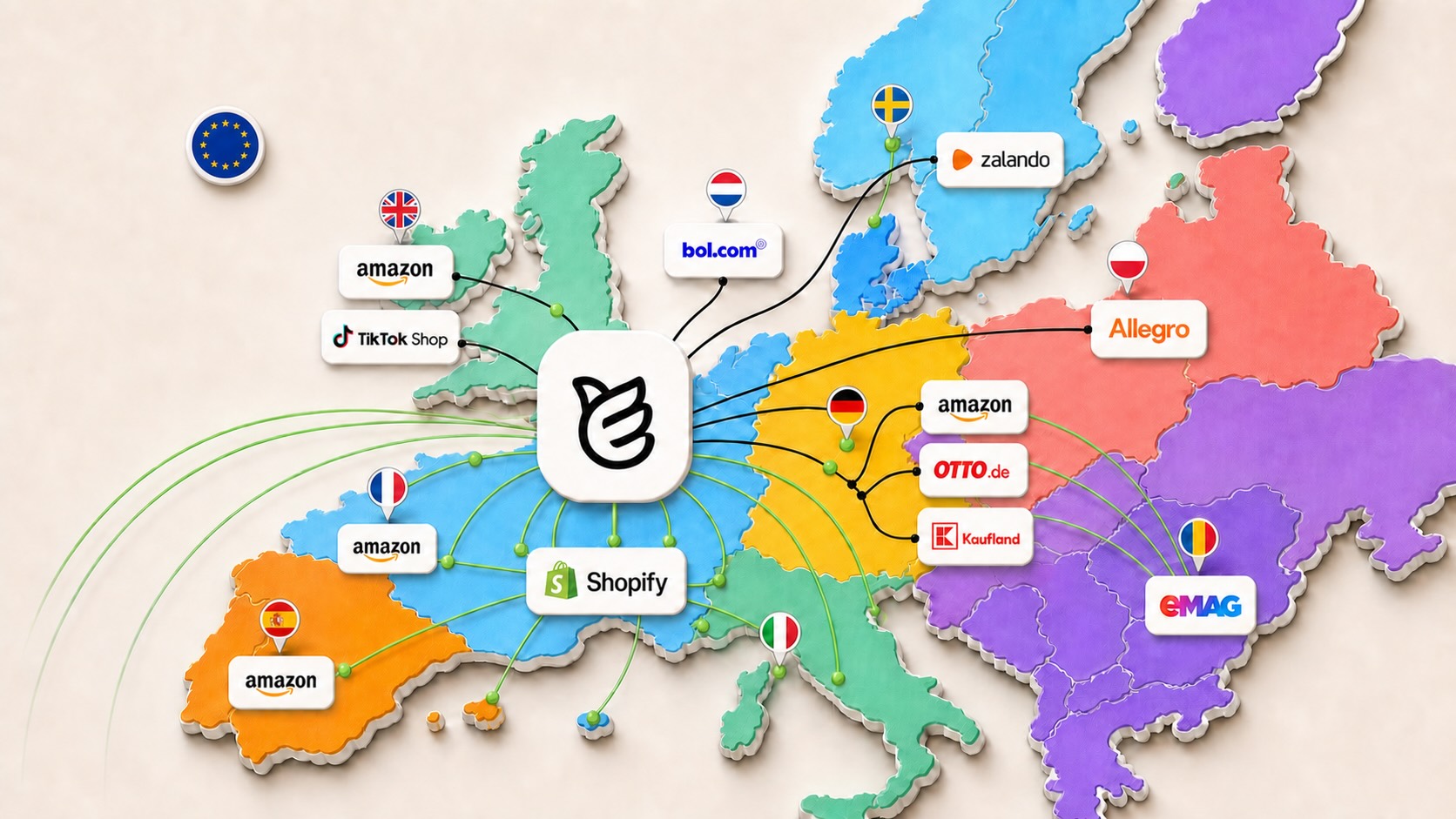
Every party that can resell your product is a potential source of an unauthorized listing. A brand running six distributors across Europe and North America has six places where stock can leak, six sets of terms to police, and six sources of the surplus that eventually surfaces on Amazon at a price you never approved. A brand whose channels are operated by one accountable party has one.
That is the difference between a commerce operator and a traditional distributor, and it is not a semantic one. A distributor buys your goods, takes title, and decides what happens next, including what happens to the units they cannot sell. eBrands operates your channels as Merchant of Record without taking ownership of your brand or your inventory, which means there is no independent party downstream with stock to liquidate and no incentive to discount outside your policy. Enforcement still matters, and Brand Registry, Transparency, and disciplined reporting remain part of the work. They are simply much easier when there is only one legitimate seller to account for. If unauthorized sellers keep reappearing on your listings no matter how many you remove, the leak is upstream, and our team can help you find it.
Frequently asked questions
Can Amazon remove a seller for selling my genuine product?
Generally no. If the units are authentic and not materially different, Amazon treats it as a legitimate resale and will not act on a counterfeit or IP claim. Removing gray-market sellers requires addressing where they obtained the stock, or a material-difference or product-safety basis if one genuinely exists.
Do I need a registered trademark for Amazon Brand Registry?
You need an active registered trademark or, in many cases, a pending application filed with a recognised government IP office. Amazon's IP Accelerator connects brands with attorneys to shorten the path if you have not filed yet.
How long does an Amazon infringement takedown take?
Report a Violation claims typically resolve in about 7 to 14 days. Project Zero, for brands that qualify, allows self-service removals in roughly 24 to 48 hours because Amazon does not review them first.
Is the Transparency program worth it?
For brands facing repeat counterfeiting, usually yes, because it is the only Amazon tool that authenticates individual physical units before they ship. The cost is operational: serialised codes must be applied during manufacturing, which affects production and packaging.
Does the end of commingling stop counterfeits?
It closes one significant route, since fake units can no longer be pooled with genuine stock and shipped against your listing. It does not stop counterfeiters listing their own offers, so listing-level enforcement and, where justified, Transparency remain necessary.

“ We are dedicated to assisting you; please contact us for any information or inquiries you may have. ”









%2520-%2520Copy.jpeg)
_Nick_Fancher_Photos_ID6071.jpeg)
.jpeg)