Agentic Commerce for Physical-Goods Brands: What Changes When AI Agents Place the Order
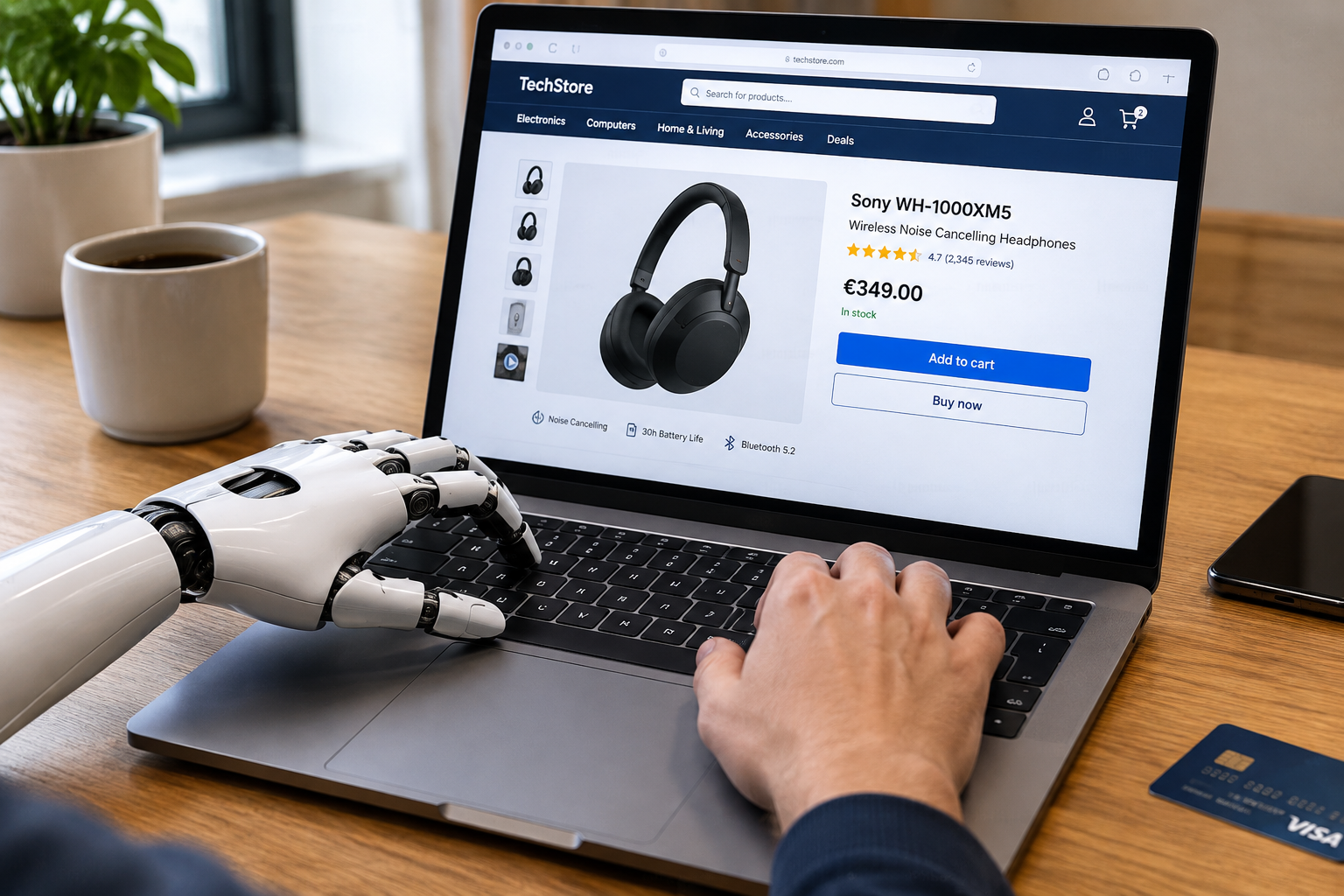
The story most brands heard about agentic commerce was that customers would soon tell an AI assistant what they wanted and the assistant would buy it, ending the storefront as we know it. What actually happened in 2026 is more useful and less dramatic. Checkout inside the chat window launched, expanded, and was then quietly pulled back within weeks, while the discovery layer in front of it kept growing fast. The practical shape for now is that agents increasingly decide which products a shopper sees, and the purchase still happens on the merchant's own rails. That distinction determines what you should be spending money on this year.
The short answer: agentic commerce is AI agents acting on a shopper's goal rather than a click, handling discovery, comparison and sometimes payment. For physical-goods brands in 2026, the winnable part is being discoverable and buyable by agents, not rebuilding checkout.
Key takeaways
- AI-referred traffic to retail sites grew several thousand percent between 2024 and 2025, so the discovery shift is real and measurable.
- In-chat checkout stalled in 2026. OpenAI withdrew Instant Checkout in March and repositioned around discovery and retailer-operated apps.
- Several competing protocols now carry agent commerce, and most merchants will eventually support more than one.
- Agent checkout is largely US-first, so European brands should prioritise discoverability and data quality over integration.
- Under the main protocols the merchant remains merchant of record, which means liability for tax, compliance and returns does not move to the agent.
What is agentic commerce?
Agentic commerce is the model where an autonomous AI agent acts as a proxy for the buyer, working from a goal rather than a query. Instead of a shopper browsing a category and clicking Add to Cart, they say something like "find trail running shoes under €150 that arrive before Friday", and the agent evaluates options across merchants, checks availability and delivery, and in some configurations completes the purchase.
It is worth separating three things that get blurred. Conversational commerce keeps the human in every step: the assistant answers, you click. Agent-assisted discovery means the agent shortlists and recommends, then hands you to a merchant to buy. Full agentic checkout means the agent transacts on your behalf. Most of what exists today is the middle one, and the gap between the middle and the third is where the 2026 story sits.
The demand signal underneath is not ambiguous. Adobe Analytics measured a 4,700% year-on-year increase in generative-AI referred traffic to US retail sites between July 2024 and July 2025, and 805% year-on-year growth during Black Friday week in 2025. Around 45% of consumers now report using AI somewhere in the buying journey. Whatever happens to checkout, the discovery shift has already happened.
What actually shipped, and what got pulled
The timeline matters here more than the vision, because a lot of published advice is built on features that no longer exist in the form described.
OpenAI and Stripe released the Agentic Commerce Protocol and launched Instant Checkout inside ChatGPT in September 2025, starting with Etsy sellers and then Shopify merchants. OpenAI's own description is a good summary of the design: orders, payments and fulfilment stay with the merchant using their existing systems, and ChatGPT acts as the user's agent passing information between the two. The feature was broadened to all US users in February 2026, with a 4% merchant transaction fee.
Then it was withdrawn. Multiple accounts place the removal in early March 2026, with roughly thirty merchants live at the time and the experience hampered by pricing and inventory data that was not reliable enough. OpenAI repositioned around product discovery and retailer-operated apps, with partners including Walmart, Target, Etsy and Instacart running their own experiences inside ChatGPT. The protocol survived as infrastructure; the consumer-facing shape changed.
Google moved the other way. It launched the Universal Commerce Protocol at NRF in January 2026, co-developed with Shopify, Etsy, Wayfair and Target, and by March had added multi-item carts, real-time catalogue queries and loyalty identity linking. Google's Shopping Graph holds over 50 billion listings with around two billion refreshed hourly, and AI Mode has tens of millions of daily users, which makes it the deepest commerce infrastructure of the group even though it is less discussed.
The conclusion drawn by Digital Applied's analysis of the retreat is the one worth internalising: the industry regrouped around discover in AI, buy on site. That is a far more manageable brief than rebuilding your checkout.

The protocol layer, in plain terms
You do not need to implement these yourself in most cases, but you should know which ones your platform supports, because that determines which agents can transact with you.
Two developments suggest this is consolidating rather than fragmenting further. AP2 moved to standards-body governance under the FIDO Alliance in April 2026, and UCP was explicitly designed to interoperate with the others, as the timeline compiled by No Hacks records. Payment networks have also started shipping protocol-agnostic on-ramps that accept several standards at once, which reduces the risk of betting on the wrong one.
What does not change: you are still the merchant of record
This is the part physical-goods brands most often get wrong, because the framing of "the agent buys it" implies the agent takes on the transaction.
It does not. Under ACP as designed, the merchant fulfils the order and remains merchant of record, with payment passing through a token so the agent never handles card details. Everything that follows from being merchant of record follows exactly as before: VAT or sales tax collection and remittance in the country of sale, consumer law obligations including withdrawal rights in the EU, product compliance, chargeback exposure, and the returns process. If an agent buys a product for a German consumer, German consumer law applies to that sale, and the entity responsible is whoever the merchant of record is, not OpenAI or Google.
The same applies to importing. Goods still cross borders physically, so an importer of record is still required, and duty still attaches at the same rates. Agentic commerce changes the front of the funnel, not the legal and logistical spine behind it. The distinction between the roles is set out in our comparison of merchant of record and seller of record, and it matters more, not less, when a third-party surface sits between you and the buyer.
There is one genuinely new liability question, and it is unsettled: when an agent makes a mistake, ordering the wrong variant, the wrong quantity, or misreading a delivery promise, whose problem is the return? Today it lands with the merchant, as any other return would. Emerging consent frameworks aim to create an auditable record of what the user actually authorised, which may eventually shift some of that, but nobody should plan on it yet.
Where the legal ground is still moving
Platforms are actively deciding which agents may transact on their surfaces, and the answers are not settled. eBay barred third-party buy-for-me agents from placing orders in February 2026. Amazon has litigated against agent-driven shopping on its site, with an injunction against one provider later vacated on appeal in August 2026. Marketplaces have obvious reasons to prefer their own agents over someone else's, and brands should not assume an agent that works on your own store will be permitted on a marketplace listing.
This is worth watching rather than acting on. The practical implication for now is simply that your own storefront is the surface where you control agent access, and marketplace agent policy is someone else's decision.

What brands should actually do now
The useful work is unglamorous and it pays off regardless of which protocol wins.
Fix your product data first. Agents cannot evaluate what they cannot parse. Complete, accurate, structured attributes, real dimensions and materials, current price and stock, and clear variant relationships are the difference between being shortlisted and being invisible. A recurring finding across the sector is that mid-market brands are often auto-enrolled into AI shopping surfaces through their platform, yet their products never surface because the catalogue was never structured for machine evaluation. That is a solvable problem and it is the highest-return item on this list.
Make sure price and availability are true everywhere. Part of why in-chat checkout struggled was inaccurate pricing and inventory data pulled from scraping. Agents penalise unreliability quickly, and a brand whose feed says in stock when it is not will lose recommendation slots on every surface at once.
Keep price parity across channels. An agent comparing your product across marketplaces and your own store will surface the cheapest credible offer. If unauthorised sellers are undercutting you, the agent will route the sale to them, and no amount of protocol work fixes that.
Treat your own site as the destination. Since the model has settled on discover in AI, buy on site, the conversion work that already matters, clear delivery promises, straightforward returns, fast pages, still matters. The traffic simply arrives pre-qualified from a different place.
Measure it. AI-referred traffic is already showing up in analytics as its own source. Separate it, watch its conversion rate against organic and paid, and you will know whether this is a channel for you long before the trade press does. A consolidated view across channels is what makes that comparison meaningful, which is the job Apollo Intelligence does for the brands we operate.
Do not rebuild checkout yet. If you are on a major platform, the protocol integrations are being built for you. For European brands especially, agent checkout remains largely a US-first capability with platform and payment requirements attached, so the integration work has limited near-term value compared with the data work above.
How this fits an international brand
Agentic commerce is being built US-first, which creates a familiar pattern for anyone who has watched a commerce trend land in Europe eighteen months late: the discovery effects arrive early and globally, the transaction infrastructure arrives later and market by market. European brands should read that as a reason to invest in data and discoverability now and to hold off on integration spend.
The deeper point is that agents do not remove any of the obligations that make cross-border selling hard. Whoever is merchant of record for physical goods still owes the VAT, still answers to consumer law, still processes the return, and still needs an importer behind the stock. What changes is that a new intermediary now influences which products get considered at all, across every channel you sell on including Amazon, where Rufus is doing the same job inside Amazon's own walls.
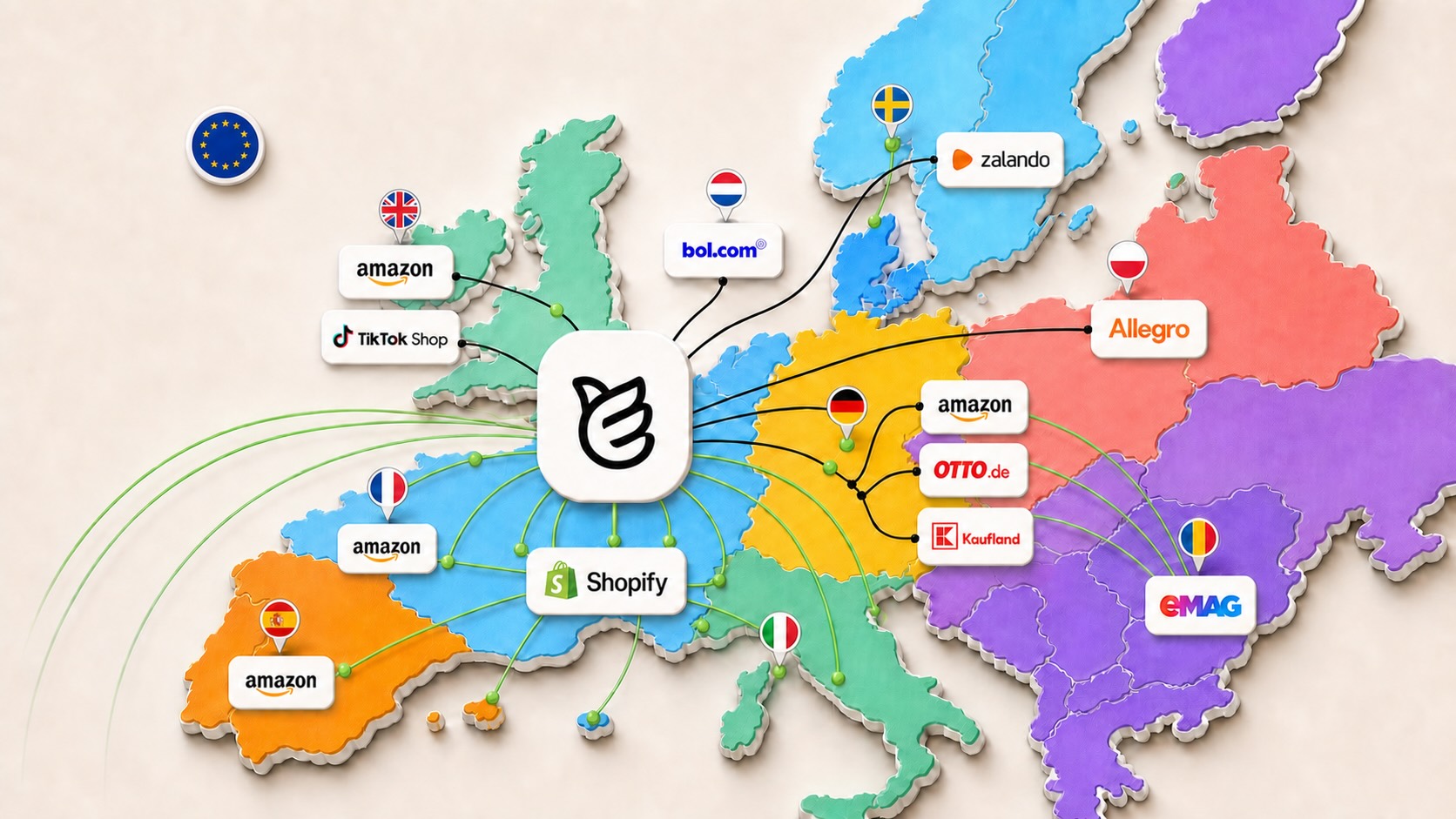
eBrands operates that spine for the brands we work with: merchant of record and importer of record in each market, channels and product data managed centrally, and one consolidated view of what is actually converting. We wrote about the strategic shift in when AI becomes the cart, and the operational answer has not changed since: get the data right, keep the compliance covered, and let the discovery layer find you. If you want to know whether AI-referred traffic is already reaching your products, that is measurable today, and our team can help you look.
Frequently asked questions
What is agentic commerce?
A model where an AI agent acts on a shopper's goal rather than their clicks, handling discovery, comparison and sometimes the purchase itself across merchants, inside a chat surface, browser or wallet.
Can customers buy directly inside ChatGPT?
Not in the general form launched in 2025. OpenAI withdrew Instant Checkout in early March 2026 and repositioned around product discovery and retailer-operated apps, so purchases now typically complete on the retailer's own systems. The underlying protocol remains in use.
Who is responsible for tax and returns on an agent-driven sale?
The merchant of record, exactly as on any other sale. The agent passes information and payment but does not assume VAT, consumer law, product compliance or returns liability.
Do I need to implement ACP or UCP?
Usually not directly. Major ecommerce platforms are building protocol support for their merchants. The higher-value work for most brands is structured, accurate product data and reliable price and stock feeds.
Does agentic commerce matter yet for European brands?
The discovery side does, and it is already measurable in analytics. Agent checkout is largely US-first with platform and payment requirements attached, so European brands generally get more return from data quality and price parity than from integration work today.

“ We are dedicated to assisting you; please contact us for any information or inquiries you may have. ”