Seller Fulfilled Prime in 2026: The Real Requirements, and When It Beats FBA

The Prime badge is the most valuable piece of real estate on an Amazon listing. It raises conversion, it filters you into the Prime-only searches that a large share of customers never leave, and for most brands the only way to get it is to hand Amazon the inventory and pay the FBA fees.
Seller Fulfilled Prime is the other way. You keep the stock in your own warehouse or your 3PL, you ship it yourself, and the badge appears on the listing anyway. For a brand with oversize goods, high-value goods, short shelf life, or a fulfilment operation it already pays for, that sounds like the obvious answer.
It is a harder programme than it looks, and it got harder in 2026. Amazon raised the delivery speed thresholds on 6 July, and the grace period that kept weekends out of the speed calculation ended on 17 October. Most of the guidance currently circulating was written before either change and quotes thresholds that are no longer the ones you will be measured against.
Here is what the programme actually demands now, where the three main versions of it differ, and the short list of situations where it is genuinely the better trade.
What Seller Fulfilled Prime is
SFP lets you display the Prime badge on listings you fulfil yourself. Amazon sets the delivery promise, the customer sees Prime delivery speeds and free Prime shipping, and you are the one who has to make that promise true, out of your own warehouse, with your own carrier contracts, at your own cost.
Three consequences follow from that and they shape everything else:
You pay the shipping. Prime delivery is free to the customer. It is not free to you. There is no FBA fee, but there is a one-day or two-day carrier bill on every order, and in oversize categories that number is not small.
Amazon owns the customer. Customer service and the returns experience run under Amazon's returns policy, not yours. You agree to that as a condition of entry.
The badge is conditional and continuously assessed. It is not a status you earn once. Performance is measured on a rolling basis and the badge comes off listings, or off the account, when you drop below the line.
What changed in 2026
Two changes matter, and both are recent enough that a lot of published advice has not caught up.
6 July 2026: the speed thresholds went up. SFP is not judged only on whether you deliver on time. It is judged on how fast a delivery date you can show to Prime customers in the first place, measured as a share of Prime page views. Amazon raised that bar across all three size tiers.
In proportional terms the extra large two-day requirement is the steepest move, up by two thirds. For a single-warehouse operation these are coverage requirements in disguise: showing a one-day date to 40% of Prime page views is not a carrier upgrade, it is a question of how much of the country sits within one-day ground reach of your building.
17 October 2026: weekends now count. Until that date weekends were excluded when Amazon evaluated these speed metrics. They are not any more. A warehouse that ships Monday to Friday and lets the weekend absorb the gap will see the metric fall, because the metric now reflects what a Saturday shopper is actually shown. Weekend dispatch was already a requirement of the programme; as of last month it is also visible in the number that decides whether you keep the badge.
Alongside this, Amazon released a delivery-promise tool in September 2026 that lets sellers set shipping times, cut-off times and weekend availability at postcode level rather than as one blanket setting. If your coverage is uneven, that tool is the lever that makes these thresholds survivable, because it stops a conservative national default from dragging your promise down everywhere.

The performance gates
Speed is one half. The other half is reliability, measured continuously, with thresholds that are materially stricter than ordinary seller-fulfilled standards.
The headline figures across marketplaces sit roughly here: on-time delivery in the mid-90s or higher, cancellation rate under 0.5%, order defect rate under 1%, and Amazon Buy Shipping used on effectively all orders — 98% or more, with some marketplaces stating 99%. Buy Shipping is not a convenience in this programme, it is the mechanism Amazon uses to verify your performance, and buying labels outside it on more than a sliver of orders puts the badge at risk by itself.
Published figures differ between marketplaces and between sources, and Amazon adjusts them. Treat any number you read anywhere, including here, as a planning figure and confirm the current ones in Seller Central for the specific marketplace you are enrolling in before you commit the operation.
Enforcement runs in three steps. The first breach is a warning. The second pauses Prime on your listings. The third removes you from the programme, and getting back in means a fresh trial — with a cap of three trials per calendar year. That cap is worth noting before you treat enrolment as something to try casually.
It is not one programme
This is where most guides mislead. "Seller Fulfilled Prime" is the US name for a family of programmes that differ by marketplace in ways that change whether you can qualify at all.
The German carrier constraint is the one that catches brands out. A single approved carrier means your entire Prime operation in that market depends on one network's coverage, pickup windows and weekend service. If DPD does not reach your customers fast enough from your warehouse, there is no second option to try.
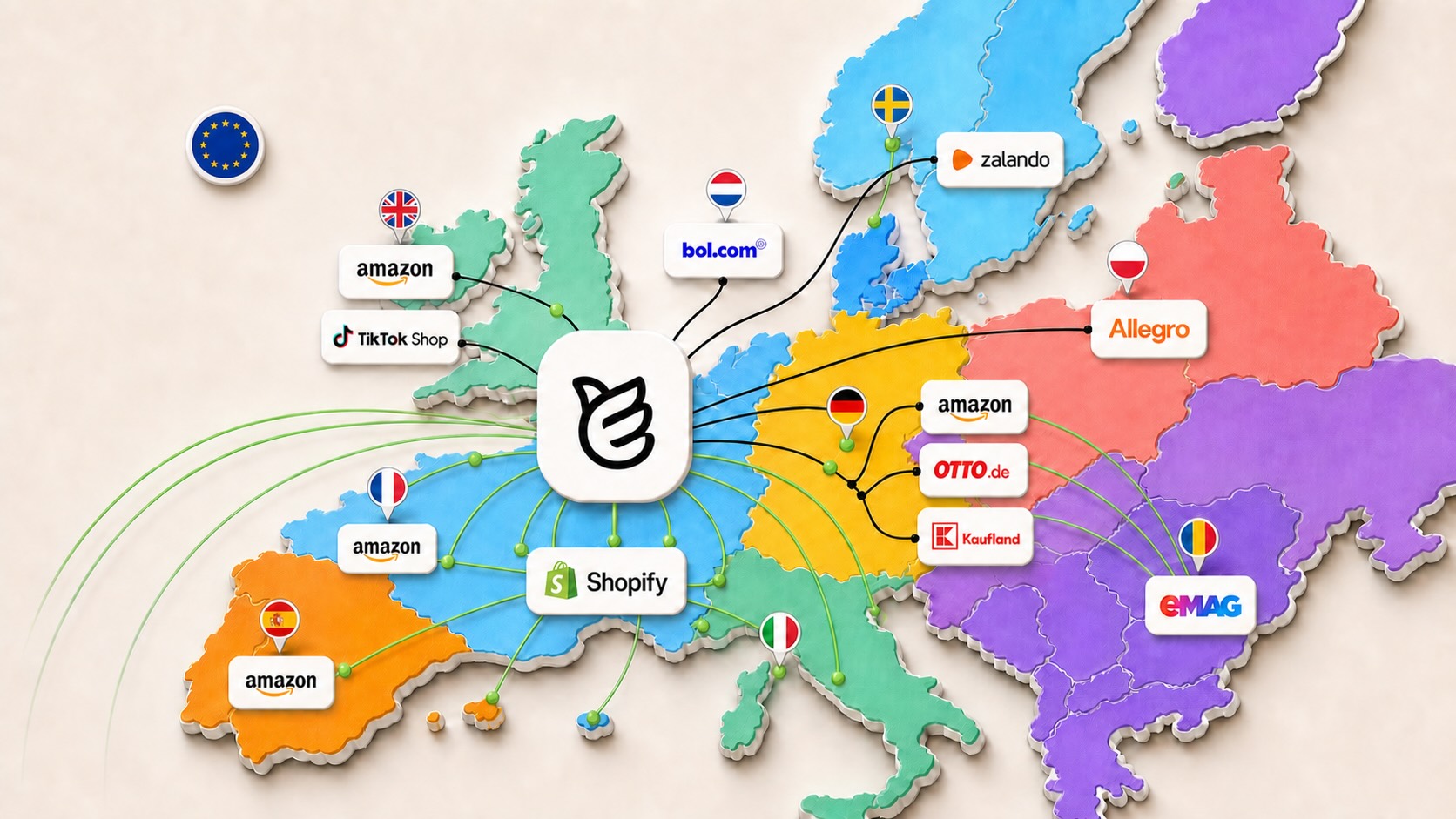
The practical point for a brand expanding across Europe: SFP is a per-marketplace decision requiring per-marketplace infrastructure, not a programme you switch on for the region. Qualifying in the UK tells you nothing about whether you can qualify in Germany.
What it costs
There is no Seller Fulfilled Prime programme fee. This is worth stating plainly because there nearly was one: in August 2023 Amazon announced a 2% fee on SFP orders, due to start that October, and dropped it weeks later as the US Federal Trade Commission's antitrust suit landed. It has not returned. If you see a monthly figure quoted — £25 in the UK, for instance — that is the Professional selling plan, which you would be paying anyway.
The cost sits entirely in the operation:
Carrier spend. Expedited shipping on every order, absorbed by you. This is the dominant number and it scales with every unit you sell, which makes SFP economics the mirror image of FBA's: no per-unit Amazon fee, but a per-unit carrier bill you cannot batch away.
Weekend labour. Saturday dispatch is a requirement, not an optimisation. That means staffed weekend picking and a carrier collection that actually happens, every week, including the awkward ones.
Returns. They come back to you, under Amazon's returns policy rather than yours, and for cross-border sellers that is a reverse logistics problem with a cost attached.
Inventory held in the right place. Meeting a one-day promise for 40% of page views is a network question. One warehouse rarely does it in a large country, which pushes you toward multiple locations and the inventory split that comes with them.
Systems. Buy Shipping integration, accurate cut-off times, postcode-level promise settings, and the monitoring to catch a metric sliding before Amazon does.

When SFP is actually the right call
For most brands it is not. If your products are standard-size, moderately priced and turn over predictably, FBA gives you the badge, the network and the weekend cover for a fee that is almost certainly lower than running the same service yourself. The honest default is FBA.
SFP earns its place in a narrower set of cases:
Oversize and heavy goods. FBA fulfilment and storage fees on bulky items can exceed what your own freight arrangement costs, particularly if you already ship these products for a D2C or wholesale channel. The oversize thresholds are also the easiest ones to clear.
High-value or slow-turning inventory. FBA's aged-inventory charges punish stock that sits. Goods with a long sales cycle and a high ticket are often cheaper to hold in your own building.
Products FBA will not take, or handles badly. Hazmat classifications, temperature sensitivity, short shelf life, fragile items with high damage rates in third-party handling.
Made-to-order, personalised or configured goods. Anything that cannot physically exist in a fulfilment centre before the order is placed.
You already run the warehouse. If a mature operation with weekend cover and strong carrier rates exists for other channels, the marginal cost of adding Prime orders to it is much lower than the standalone case, and the badge is close to free margin.
You want the inventory under your control. Stock in your own building can be redirected to wholesale, retail or D2C in a week. Stock in an Amazon fulfilment centre cannot, and that optionality is worth real money to a brand running several channels.
The test is straightforward. Model your fully loaded cost per order — expedited carrier, weekend labour, returns handling, the share of warehouse overhead — and set it against the FBA fee for the same unit in the same marketplace. If SFP does not win on that comparison before you have even considered the performance risk, it will not win after.
Frequently asked questions
Does Seller Fulfilled Prime help you win the Buy Box?
Indirectly. Prime eligibility and strong fulfilment metrics are positive signals, and the badge lifts conversion, which helps. But the Buy Box is decided by price, availability and seller performance together, and SFP does not override any of them. If you are losing the Buy Box to resellers on your own listing, SFP is not the fix — removing the resellers is.
Can a 3PL run SFP for me?
Yes, and many do, provided they can hit the metrics, use Buy Shipping, dispatch at weekends and meet the cut-off times. Your badge depends entirely on their execution, so the SFP requirements belong in the contract with explicit service levels, not in the onboarding call. Not every 3PL can do it.
Can I use SFP and FBA at the same time?
Yes. Many brands put oversize or slow-moving SKUs on SFP and keep fast-turning standard-size items in FBA. They are assessed separately, so a weak SFP operation does not endanger your FBA listings, though it does occupy management attention.
What happens if I lose the badge?
You keep selling. The listing reverts to standard seller-fulfilled, loses the Prime badge and drops out of Prime-filtered search, which usually shows up as a visible conversion fall. Depending on the breach you may be paused on affected listings or removed from the programme and required to complete a new trial.
Does SFP work for a brand without a local entity?
The fulfilment address must be domestic in each marketplace, which is the binding constraint rather than company registration. In practice you need stock in-country, a compliant importer arrangement to get it there, and someone to take the VAT and customs obligations. That infrastructure question usually decides the answer well before the performance metrics do.
Is SFP available in every European marketplace?
No. Availability and programme design vary by marketplace, and some do not offer a seller-fulfilled Prime equivalent at all. Check the specific marketplace rather than assuming regional parity.
Where this fits
Seller Fulfilled Prime is a fulfilment decision dressed up as a marketing one. The badge is the visible part; what you are actually signing up for is a service level that was designed around Amazon's own logistics network, now assessed against stricter speed thresholds and with weekends fully in scope since October.
If the operation already exists and the products suit it, the economics can be excellent. If it does not, the badge is an expensive thing to buy.
eBrands fulfils and sells for brands across Amazon and twenty other marketplaces in Europe and North America, as the seller and importer of record in each market, which means the local entity, the stock position and the carrier contracts are already in place. If the question is whether a given SKU is better on FBA, on SFP or on neither, Apollo Intelligence is where that comparison gets made on real fulfilment cost rather than list fees.

“ We are dedicated to assisting you; please contact us for any information or inquiries you may have. ”