Multi-Channel Inventory Management: How to Sell Everywhere Without Overselling

Overselling is the error that costs most per incident and gets the least planning. A customer orders a product that is not there, you cancel, Amazon records a defect against your account, the customer leaves a review about it, and the cancellation rate that follows can affect every listing you have rather than the one that failed. Adding channels multiplies the chance of it happening, which is why the inventory problem usually arrives at exactly the moment a brand starts growing properly.
The short answer: run every channel from one stock pool, update it automatically on every order and every stock movement, and hold a small buffer on the channels where a cancellation hurts most.
Key takeaways
- A sales channel is not a source of truth. Shopify and Amazon each know only what they sold.
- Real-time sync alone does not prevent overselling, because two channels can accept the same unit within the same second.
- Publish sellable stock rather than on-hand stock, with reservations and buffers deducted.
- Mismatched SKUs are the most common root cause of sync failures.
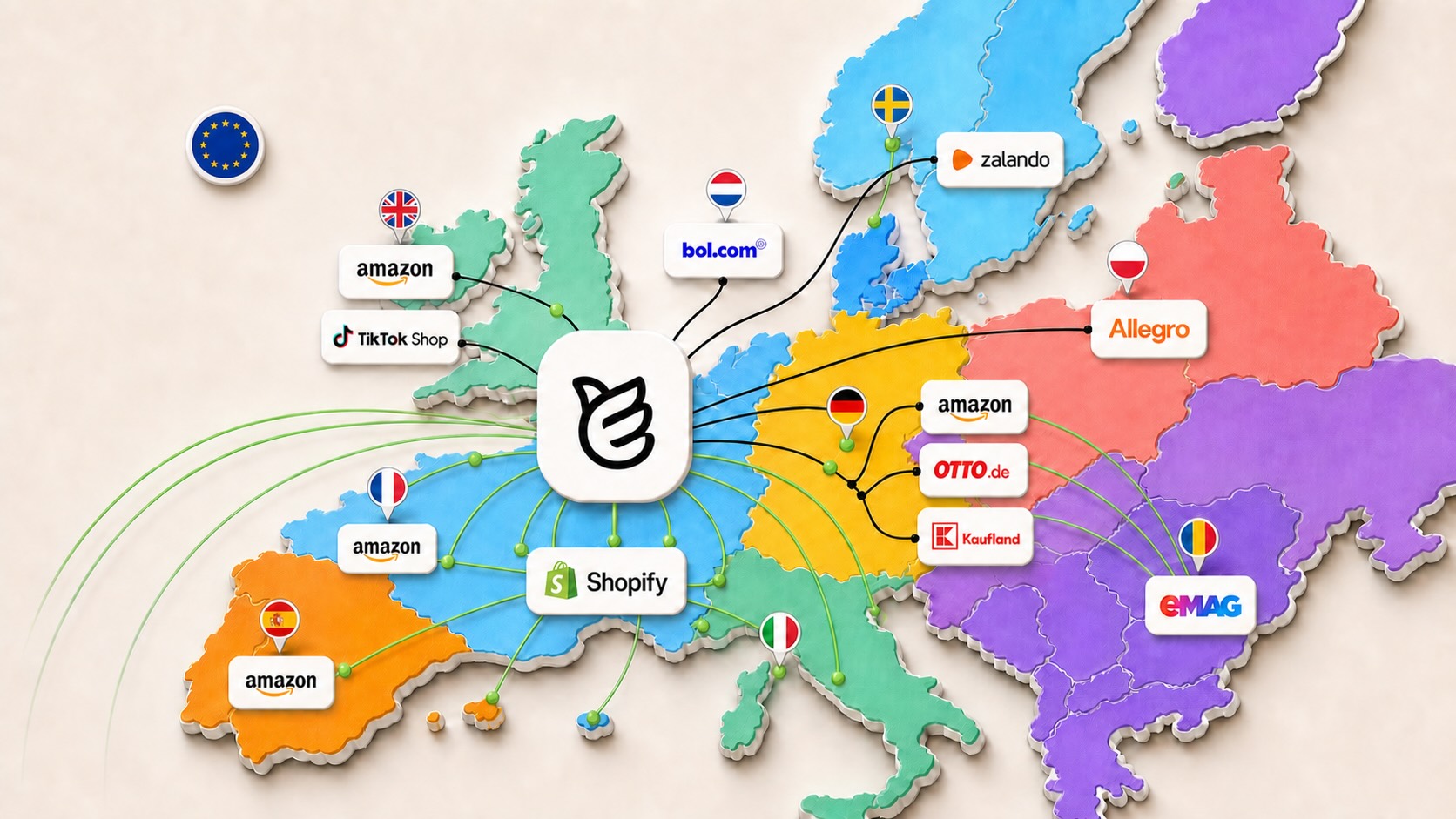
- Pooling works inside a market and breaks across borders, where stock is physically and legally fragmented.
Why it goes wrong
Every channel keeps its own stock record and knows only its own sales. Shopify does not know what Amazon sold. Amazon does not know what the Walmart listing moved. Left alone, each one keeps selling from a number that was accurate when it was last written.
That produces four recurring failures. Stock that does not sync, so a product sold on one channel stays live on another. Stock that is physically split, with units in an Amazon fulfilment centre, a Walmart fulfilment centre and a 3PL warehouse, none of which can serve the others. Numbers that are wrong at source, because what the system believes is on the shelf and what is actually there have drifted. And demand that spikes on one channel during a promotion, draining the pool faster than anyone expected.
The first mistake underneath all of them, as Techspawn's operator playbook puts it, is treating a sales channel as the source of truth. Shopify, Amazon and Walmart are places you sell. The source of truth has to sit above them, holding one number that every channel reads from.
The three layers that stop overselling
Preventing oversells is not one mechanism. It is three, and brands that implement only the first keep overselling and cannot work out why.
Real-time sync. When a sale happens anywhere, every other channel's quantity updates within seconds. Sub-five-second propagation is the current expectation, and anything on a five or fifteen minute polling schedule leaves a window wide enough to drive a peak-season disaster through.
Locking during simultaneous sales. This is the layer most articles skip. Even with instant sync there is a race condition: Amazon's order webhook is still being processed when a Shopify shopper grabs the same unit. Without a lock on the record during the transaction, two channels can both succeed against one unit. Fast sync narrows the window; locking closes it.
A safety buffer. Holding back a small reserve, commonly a few units per SKU or around 5% to 10% of stock, absorbs whatever gap remains. The buffer should not be uniform. Weight it toward channels where a cancellation carries a real penalty, since Amazon treats oversells far more harshly than most storefronts do.
One honest caveat worth passing to anyone promising zero oversells: independent marketplaces do not share a single atomic checkout reservation, so the risk can be reduced to a few seconds and not eliminated entirely. Build for recovery as well as prevention.
Publish sellable stock, not on-hand stock
This distinction does more practical work than any software feature, and it is where most homegrown setups go wrong.
On-hand stock is what physically exists. Sellable stock is what you can safely promise, which is on-hand minus units reserved against accepted orders, minus the safety buffer, minus anything damaged or quarantined, minus stock committed to a wholesale order that has not shipped yet.
Incoming inventory should be kept out of the sellable figure entirely until it is received and verified. Publishing a purchase order as available is a decision to sell units that a delayed container or a short delivery can turn into cancellations.
The operating principles that follow, set out well by Retoolers, are to reserve stock when an order is accepted rather than when it ships, publish sellable rather than raw quantities, apply safety stock based on demand and lead-time uncertainty, and keep incoming stock separate from available stock.
The unglamorous prerequisite: SKUs
Before any of this works, your product identifiers have to match across every system.
"Black Cotton T-Shirt – L" on Shopify and "Cotton T-Shirt Black Large" on Amazon are two different products as far as any sync tool is concerned. Clarus WMS identifies mismatched SKUs as the root cause of most multichannel inventory failures, and the fix is tedious rather than technical: one naming convention, applied everywhere, before connecting any tool.
Stock accuracy also starts in the warehouse rather than in the software. If goods are booked in by eye rather than by barcode scan, the central number is wrong from the first day and every channel inherits the error faithfully. A central system propagates accuracy and inaccuracy with equal efficiency.

Where pooling breaks: borders
Everything above assumes one pool of stock that any channel can draw on. For a brand selling in one country, that mostly holds. Across borders it does not, and this is the part the software content does not cover because software cannot fix it.
Stock in a US fulfilment centre cannot serve a German order without being exported, re-imported and cleared. Stock sitting in Amazon's European network under Pan-EU is distributed across several countries, each of which creates a VAT registration obligation where the goods physically sit. Units in Walmart's network cannot fulfil an Amazon order, and using Amazon's fulfilment to ship Walmart orders breaches Walmart's policy outright.
So a brand selling across the US and Europe on several channels does not have one inventory problem. It has a set of pools that are physically and legally separate, with a different sellable number in each, and a planning question about how much to commit to each one. That is a forecasting and allocation problem rather than a sync problem, and no connector solves it.
Three consequences are worth planning around. Allocation decisions become real commitments, because moving stock between pools means freight and sometimes customs. Safety stock has to be held per pool, which ties up more working capital than a single-market brand needs for the same service level. And returns re-enter the pool they came from, or they sit in the wrong country waiting for someone to decide.
A sensible build order
Standardise SKUs first, everywhere, before connecting anything. Then count what you actually have, physically, and reconcile it against what each channel currently claims. The gap at this stage is usually larger than people expect and it is the real starting position.
Choose a source of truth that is not a sales channel. For most brands that is an inventory or order management system, or an ERP for larger operations. Connect channels to it rather than to each other, since point-to-point connections between four channels multiply quickly and fail quietly.
Set buffers before peak rather than during it, weighted toward the channels that punish cancellations. Then build the monitoring: low-stock alerts, sync failure notifications, and a reconciliation job that compares quantities even when the sync reports success. Treat every oversell as a data point about where the system failed rather than as bad luck.
Decide your fulfilment model per SKU, because where stock sits shapes everything above. A product on FBA versus FBM is a different inventory problem, and a 3PL holding one pool for several channels is simpler to manage than three marketplace-owned networks, at the cost of the delivery badges those networks provide.
What this looks like at the operating level
Brands usually arrive at this problem in the same order. Two channels and a spreadsheet works. The third channel breaks it. A sync tool fixes the symptom. Then international expansion splits the pool physically, and the tool that solved the first problem has nothing to say about the second.
At that point the question stops being which software to buy and becomes who holds the whole picture: how much stock sits in each market, what is sellable in each channel after reservations, what is on the water, what is coming back as returns, and what that means for the allocation decision next month. Our FAQ on syncing inventory and pricing across marketplaces covers the mechanics, and the one on selling on multiple marketplaces covers the wider operating question.
eBrands runs that layer for the brands we operate. We hold the channel accounts, the in-market stock positions and the fulfilment relationships across the marketplaces and storefronts we run, with one consolidated view of inventory and performance per market through Apollo Intelligence. The inventory stays owned by the brand throughout. If you are adding channels faster than your stock picture is keeping up, that is a solvable problem and usually a measurement one first.
Frequently asked questions
What is multi-channel inventory management?
Keeping one accurate stock position across every place you sell, so a sale on one channel updates the quantity everywhere else. It combines a single source of truth, automatic sync, and rules for what is safe to publish as available.
How do I stop overselling across channels?
Three layers together: real-time sync so every sale updates every channel within seconds, locking so two channels cannot claim the same unit simultaneously, and a safety buffer weighted toward channels that penalise cancellations.
Can Shopify manage inventory across Amazon and eBay?
Shopify can sync with supported marketplaces through its marketplace connector, which covers many setups. Brands with several channels, multiple warehouses or international stock usually need a dedicated system sitting above all of them.
How much safety stock should I hold?
Commonly a few units per SKU or around 5% to 10% of stock, varied by channel rather than applied uniformly. Weight it toward fast-moving products and toward channels where an oversell damages account health.
Why can't I pool inventory across countries?
Because stock is physically and legally located. Goods in a US warehouse cannot serve an EU order without export and import, and stock held in an EU country creates a VAT obligation there. Cross-border selling means several pools, not one.

“ We are dedicated to assisting you; please contact us for any information or inquiries you may have. ”